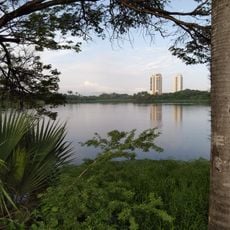
Pedra da Galinha Choca, Rock formation in Quixadá, Brazil.
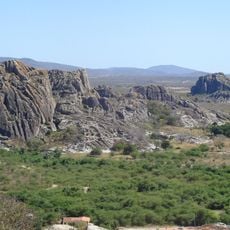
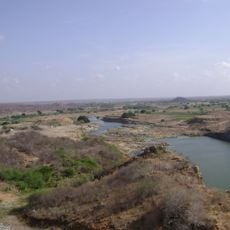
Pedra da Galinha Choca is an inselberg of diorite and granite in Quixadá, Ceará, 5 km from the city centre. Its name, Rock of the Brooding Hen, comes from the profile of the outcrop, which resembles a hen sitting on eggs. The rock is part of the Quixadá Monoliths Natural Monument, a fully protected area, and stands on Precambrian crystalline ground.
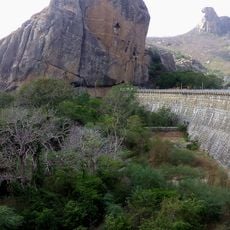
Until the early 20th century the formation was called Pedra da Arara (Macaw's Stone). Between 1890 and 1906 the Barragem do Cedro was built at its foot using stone masonry, cement and steel; on 30 January 2015 the dam was placed on the UNESCO World Heritage tentative list.
The name comes from the rock's profile, which residents liken to a hen sitting on eggs; until the early 20th century it was called Pedra da Arara, the macaw's stone. The formation lies in the Quixadá Monoliths Natural Monument, a fully protected area, and the view of the rock with the Cedro dam below is the best-known landscape of Quixadá.
The rock stands about 5 km from the centre of Quixadá, inside the Quixadá Monoliths Natural Monument, a fully protected area. The Cedro Dam, built between 1890 and 1906, lies at its foot, so the two are usually visited together. Access is on foot over exposed crystalline ground; there is no shade on the granite and diorite outcrops.
The rock was called Pedra da Arara (Macaw's Stone) until the early 20th century, when its current name, Rock of the Brooding Hen, took over. At its foot stands the Barragem do Cedro, a stone-masonry, cement and steel dam built between 1890 and 1906 and placed on Brazil's UNESCO World Heritage tentative list on 30 January 2015.
The community of curious travelers
AroundUs brings together thousands of curated places, local tips, and hidden gems, enriched daily by 94,743 contributors worldwide.