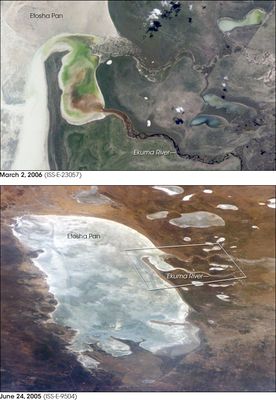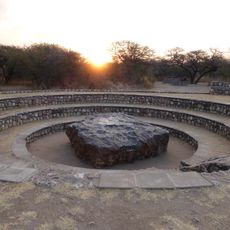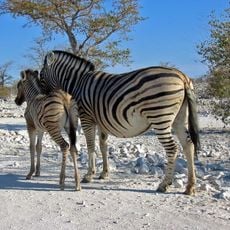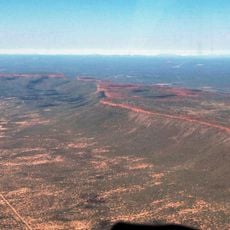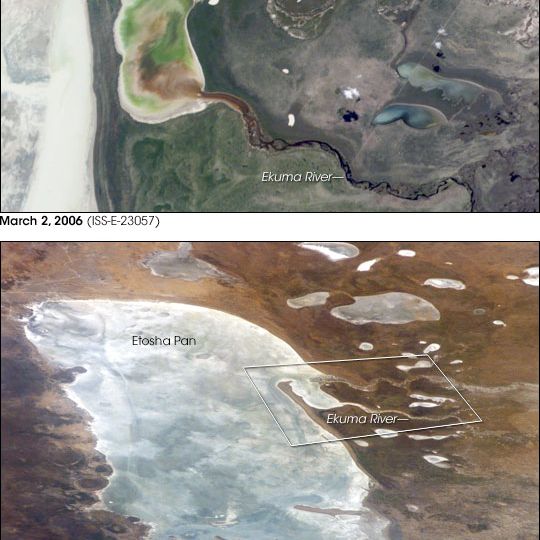
Etosha pan, Salt pan in northern Namibia.
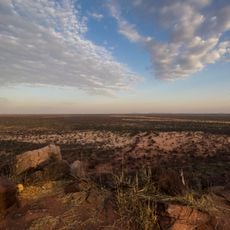
Etosha Pan is an endorheic salt pan in northern Namibia, about 120 km long and 55 km wide, covering roughly 4,800 km² at around 1,000 m above sea level. Its surface of saline clay, white and greenish from mineral deposits and blue-green algae, dries into hexagonal cracks and is largely bare of vegetation. It lies within the Cuvelai-Etosha Basin and the Owambo Basin, and is mostly dry, holding only a thin sheet of water after heavy rains.
The pan formed over roughly ten million years through tectonic activity; around 16,000 years ago a wetter climate filled it as a lake. The Kunene River once fed it until tectonic movements diverted the flow, leaving the basin to evaporate and salt over. In 1851 the Swede Charles John Andersson and Francis Galton, a cousin of Darwin, became the first Europeans to cross it, and Andersson described the salt-crusted clay in his travel report.
The name Etosha comes from Oshindonga and means 'Great White Place', after the white and greenish salt-clay surface. The pan lies in Ovamboland, and Ovambo, Herero and Haiǁom communities knew it for centuries as grazing and hunting land before John Charles Andersson and Francis Galton crossed it in 1851.
The area is highly dependent on weather conditions: the surface is hard and accessible during the dry season, but water transforms the landscape when rains arrive. Visitors should prepare for extreme conditions and use properly equipped vehicles.
After substantial rains, the pan transforms into a shallow lake that attracts thousands of flamingos and white pelicans. This seasonal shift turns rainy periods into a natural show for bird watchers and photographers.
The community of curious travelers
AroundUs brings together thousands of curated places, local tips, and hidden gems, enriched daily by 92,875 contributors worldwide.