Tintenpalast, Parliamentary building in central Windhoek, Namibia.
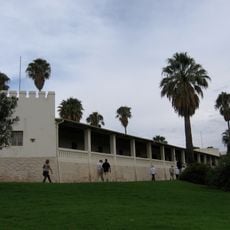
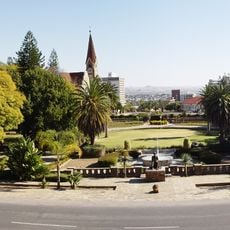
The Tintenpalast stands in Windhoek-Central, above the Christuskirche, on Robert Mugabe Avenue. German architect Gottlieb Redecker gave it a Neoclassical front façade; the firm Sander & Kock built it in 1912–1913 from regional materials. It houses the National Assembly, while the National Council meets in a newer building to its east.
Designed by Gottlieb Redecker and built by Sander & Kock in 1912–1913 from regional materials, the Tintenpalast served as the administration building of the German colonial government. The construction used forced labour by Herero and Nama survivors of the genocide, who had been placed in concentration camps. It was opened on 12 April 1913 and became the seat of the National Assembly when Namibia gained independence in 1990.
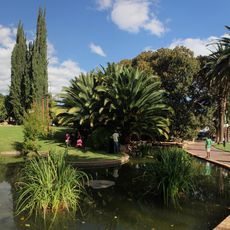
German-speaking residents of Windhoek coined the nickname "Tintenpalast" (Ink Palace) for the many clerks and their heavy ink use. The Parliament Gardens in front were begun in 1931, with planting starting in 1934; they were long popular with city residents until they closed in 2019. At the park's eastern end stand three statues: Hosea Kutako in the centre, Hendrik Samuel Witbooi on the left and Theophilus Hamuntubangela on the right.
The Tintenpalast stands in Windhoek-Central, just above the Christuskirche and north of Robert Mugabe Avenue. The Parliament Gardens in front of it, laid out from 1931, were closed in 2019. The National Council now meets in a separate modern building east of the Tintenpalast.
The nickname was coined by Windhoek's German-speaking residents, who mocked the many clerks and their heavy ink consumption. The building opened on 12 April 1913; the German source gives 1 November 1913. Since 1990 it has housed the National Assembly, while the National Council sits in a newer building to its east.
The community of curious travelers
AroundUs brings together thousands of curated places, local tips, and hidden gems, enriched daily by 94,041 contributors worldwide.