Tuynhuys, Government building in City of Cape Town, South Africa
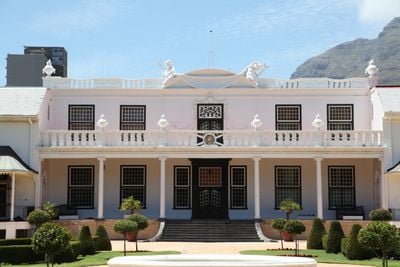
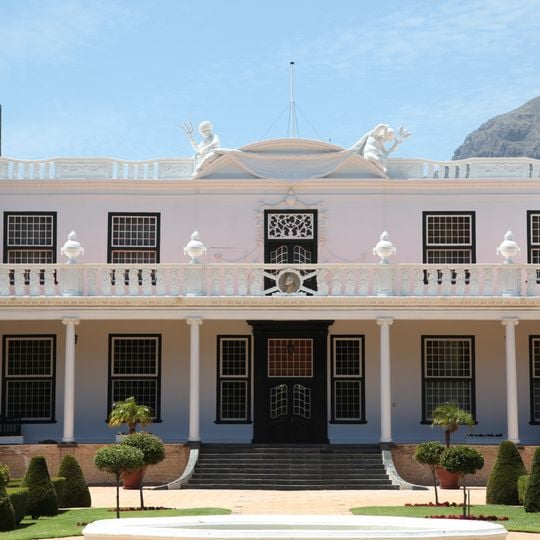
The Tuynhuys is a two-storey building in Company's Garden, Cape Town, with a pale pink upper facade and a pale blue lower one. A white balustrade with a central crest and two reclining figures tops the flat roof, and a balustraded balcony with urns runs above a colonnaded ground floor. A black double door with a fanlight opens at the top of wide grey steps.
The site was first recorded in 1674, when the Dutch East India Company built a garden toolshed for the Company's Garden laid out by Jan van Riebeeck in 1652. Around 1682 Simon van der Stel had it converted into a guesthouse, and by 1751 governors were using it as a summer residence. After 1806 Lord Charles Somerset extended it on both sides; Gabriel Fagan restored the 18th-century garden façade in 1968, and it was renamed De Tuynhuys in 1972.
The name De Tuynhuys means "Garden House", from the Company's Garden it once served. The garden façade carries sculptures of the infant Mercury and Poseidon holding a banner with the VOC emblem, attributed to Jacobus Leeuwenberg and Anton Anreith. Since 1972 the building has held its current name.
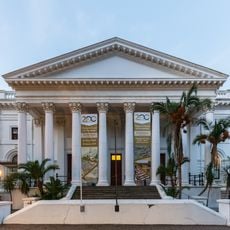
The building stands in Company's Garden between the national Parliament buildings and the President's Council, so it is seen on foot from the garden paths and surrounding streets. It is not open to the public, as it serves as the president's office. The garden façade, with its balustrade and sculptures, faces the garden side.
On March 18, 1992, President F.W. de Klerk announced the end of apartheid from the steps of this building. This moment became a turning point in South African history and transformed the location into a witness to political change.
The community of curious travelers
AroundUs brings together thousands of curated places, local tips, and hidden gems, enriched daily by 93,009 contributors worldwide.