Pinnacle Point, Archaeological site near Mossel Bay, South Africa
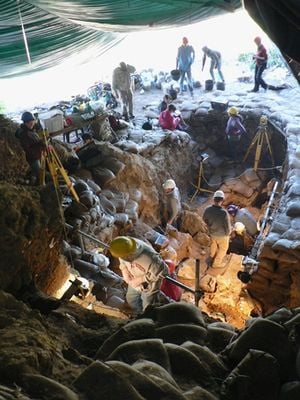
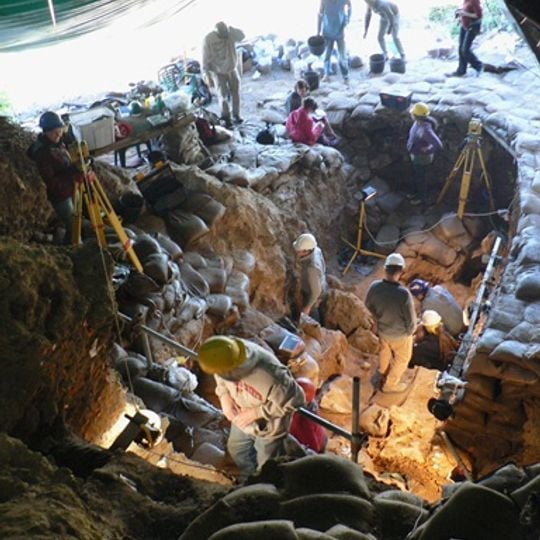
Pinnacle Point is a small promontory immediately south of Mossel Bay on South Africa's southern coast, where a series of caves opens onto the Indian Ocean. Excavations since 2000 have focused on Cave 13B (PP13B) and Cave 5–6 (PP5–6), cutting trenches into pale sandy soil and rock. The trench walls are lined and stacked with hundreds of grey-brown sandbags forming stepped, terraced surfaces on the left, right and rear sides, while the floor is flat lighter sand.
The caves were first documented in 1997 by archaeologists Jonathan Kaplan and Peter Nilssen, and excavations began in 2000 under Curtis Marean. Deposits at Cave 13B show occupation from about 170,000 to 40,000 years ago, with the only human remains dated to roughly 100,000 years ago. In 2012 Heritage Western Cape declared the site a provincial heritage site, and in 2024 it became part of the UNESCO World Heritage Site of Pleistocene Occupation Sites of South Africa.
The name Pinnacle Point comes from the promontory itself, and the caves are known by excavation codes such as PP13B and PP5–6. At PP13B, scraped and ground ochre was found, possibly used as pigment for body painting. The site also yielded the oldest known lens of shellfish remains, dated to about 164,000 years ago, evidence of early shellfish gathering.
The caves sit in a cliff face on the promontory south of Mossel Bay, reached on foot along coastal paths; the excavated trench at PP13B is lined with stacked sandbags that visitors are asked not to disturb. Access to the caves is controlled, so arrange a guided visit through a local operator before travelling out. Coastal wind and spray make weatherproof clothing useful.
At Pinnacle Point Cave 5–6 (PP5–6), excavators found the oldest known evidence of heat treatment of rock to make stone tools: silcrete was buried in embers to harden it before knapping. The site lies just south of Mossel Bay, and in 2024 the Pinnacle Point Site Complex was inscribed as part of the World Heritage Site of Pleistocene Occupation Sites of South Africa.
The community of curious travelers
AroundUs brings together thousands of curated places, local tips, and hidden gems, enriched daily by 94,562 contributors worldwide.