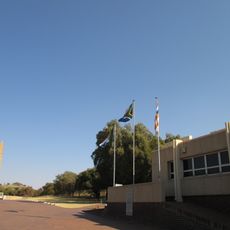
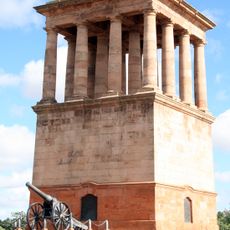
Wildebeest Kuil Rock Art Centre, Rock art exhibition site near Kimberley, South Africa.
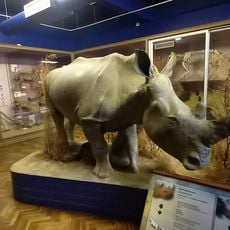
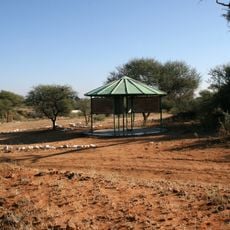
Wildebeest Kuil Rock Art Centre is a rock engraving site with a visitor centre on land owned by the !Xun and Khwe San, about 16 km from Kimberley in the Northern Cape. Most images were pecked into andesite outcrops on a hill, exposing lighter rock beneath the dark crust. Large mammals such as elephant, rhino, hippo and eland dominate, with fewer human figures than in the subcontinent's rock paintings.
George William Stow copied engravings at Wildebeest Kuil in the early 1870s and sent them to Wilhelm Bleek in 1875. Some engravings were removed late in the nineteenth century; two are now in the British Museum, and one was shown at the Colonial and Indian Exhibition in London in 1886. Gerhard and Dora Fock recorded 178 engravings in 1968, and Later Stone Age occupation debris on the hill gave radiocarbon readings of 1790±60 and 1230±80 BP.
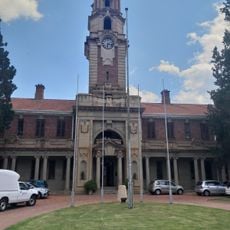
The site lies on land owned by the !Xun and Khwe San, communities resettled from Angola and Namibia, and is managed with the McGregor Museum. The engravings favour large mammals such as elephant, rhino and hippo alongside eland, and rarely show human figures, unlike the rock paintings of the Drakensberg and Cederberg.
The ground is uneven and rocky throughout the site, so sturdy footwear makes the walk more comfortable. Morning visits tend to offer the clearest light for seeing the carvings and cooler conditions than later in the day.
Many of the figures were made by pecking away the dark outer layer of rock to reveal the lighter stone beneath, creating a natural contrast that makes the images readable from a distance. This contrast between the dark surface and the pale interior is what keeps the carvings visible after so many years.
The community of curious travelers
AroundUs brings together thousands of curated places, local tips, and hidden gems, enriched daily by 93,643 contributors worldwide.