Border Cave, Archaeological rock shelter in the Lebombo Mountains, KwaZulu-Natal, South Africa
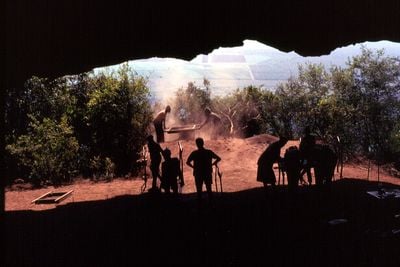
Border Cave is a rock shelter in the Lebombo Mountains that extends approximately 100 meters below the ridge line, holding layered deposits of ancient habitation. The shelter is formed within Jurassic rock formations and preserves successive settlements across different time periods.
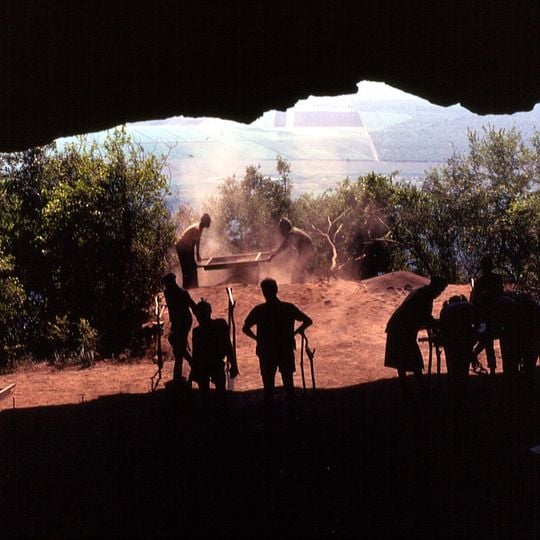
Excavations since 1934 have uncovered human remains and artifacts reaching back 250,000 years, documenting the progression from the Middle Stone Age through the Iron Age. This record represents one of the longest continuous archaeological sequences in southern Africa.
The site's finds include grass bedding, bone points and Conus shells, and some stone tools closely resemble those still made by modern San people. Scholars debate whether this means the cave's inhabitants were San ancestors; others call that ethnic identification too simplistic.
The shelter sits at 600 m above sea level, about 100 m below the Lebombo crest, with its mouth facing west over the Eswatini lowveld. Ingwavuma, roughly 12 km south, records about 820 mm of annual rain. The site is a provincial heritage site reached on foot; no constructed paths or facilities are documented.
The infant skeleton BC3, found with Conus shells, came from sediment that W.E. Horton had dug out in 1940 while quarrying bat guano; Cooke and colleagues recovered it in 1941–1942. A human mandible, BC5, gave an electron spin resonance date of 74,000 ± 4,000 years.
The community of curious travelers
AroundUs brings together thousands of curated places, local tips, and hidden gems, enriched daily by 93,010 contributors worldwide.