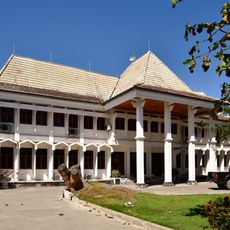
Palácio de Lahane, Portuguese colonial palace in Dili, East Timor.
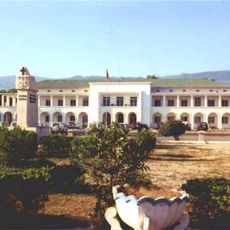
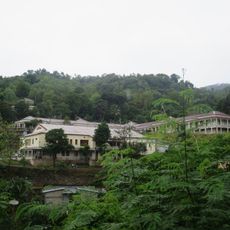
The Palácio de Lahane is a one-story pink building with octagonal towers at its corners, located in the hills south of Dili's center. The architecture combines colonial elements with decorative details that set the structure apart from other government buildings.
A house was built on the site in 1860–61 under Governor Afonso de Castro, as a first step toward moving the capital from malaria-prone Dili to the mountains. Governor João Maria Pereira planned an official residence, realised as the Palácio de Lahane under Alfredo de Lacerda Maia and built between 1884 and 1886. In the early 1930s it was replaced by a new residence with colonial art deco influences. Burned in the violence after the 1999 referendum, it was restored with funding from the Lisbon City Council.
The palace is also known as Palácio das Nobres, or Palace of the Nobles. In February 2013, when the Nicolau Lobato Presidential Palace was flooded with mud, Lahane served temporarily as the seat of the President of the Republic. Centro Nacional Chega! has proposed turning it into a centre of public recognition, with a memorial to the swearing-in of Francisco Xavier do Amaral as president on 29 November 1975 and the inauguration of the first government there the next day.
The building sits on a hill with good views of the surroundings and is easily reached by car. Visitors should know that it functions as an official government site, so access times are limited.
On 5 October, Portugal's Republic Day, the Japanese guards gave Governor Manuel Ferreira de Carvalho fish and meat to cook, the only break from the plain rice he and 18 others shared with the palace servants while confined there in 1942. On 1 September 1945 the Japanese vice consul came to the palace to tell him Japan had surrendered on 15 August.
The community of curious travelers
AroundUs brings together thousands of curated places, local tips, and hidden gems, enriched daily by 93,381 contributors worldwide.