Loch Ard Gorge, Coastal defile in Port Campbell National Park, Victoria, Australia
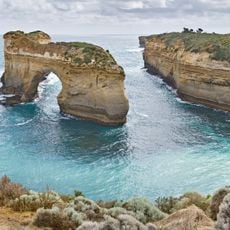
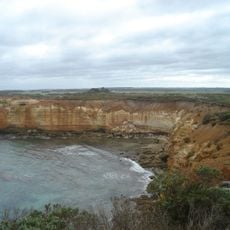
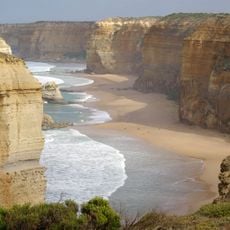
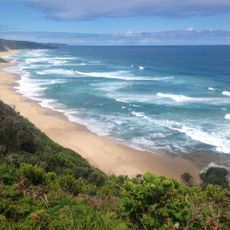
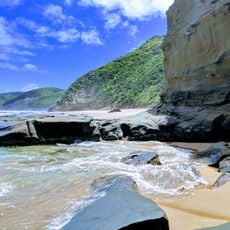
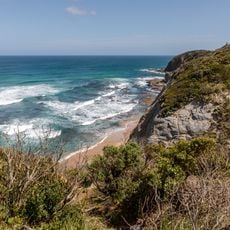
Loch Ard Gorge is a narrow inlet between two sheer limestone walls, the left one tan and cream with horizontal bands and a flat, vegetation-topped rim, the right one darker and bushy on top with a deep undercut notch at the waterline. A sandy, pebbly slope of tan and grey grains dotted with low green scrub descends to the water.
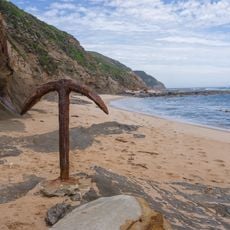
The clipper Loch Ard wrecked near Mutton Bird Island on 1 June 1878, at the end of a three-month voyage from England to Melbourne. Of 54 passengers and crew, only Thomas Pearce and Eva Carmichael, both 19, survived. Pearce was washed ashore, rescued Carmichael, then climbed out to alert pastoralists at Glenample Station. At least four passengers are buried nearby, including Eva's sister Raby and their mother Rebecca.
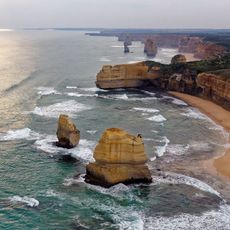
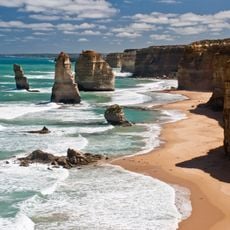
The two limestone pillars left when Island Archway collapsed in June 2009 were officially named Tom and Eva after the only survivors of the Loch Ard wreck, apprentice Thomas Pearce and Irish emigrant Eva Carmichael, both 19. Pearce was washed ashore, rescued Carmichael after hearing her cries, then climbed out to alert pastoralists at Glenample Station.
The beach stairs are temporarily closed because of geological instability and will stay shut until remediation works finish. A pathway still leads to the eastern side of the gorge. The site lies on the Great Ocean Road, 3.5 km northwest of The Twelve Apostles, and has plaques, a small museum, a rest area and a cemetery.
The rufous bristlebird (Dasyornis broadbenti), an uncommon species, is often seen in the scrub around the gorge. The site also served as a filming location for the 1982 film The Pirate Movie and the 1999 TV series Journey to the Center of the Earth with Treat Williams, and hosted the final task and finish line of the third series of The Amazing Race Australia.
The community of curious travelers
AroundUs brings together thousands of curated places, local tips, and hidden gems, enriched daily by 93,380 contributors worldwide.