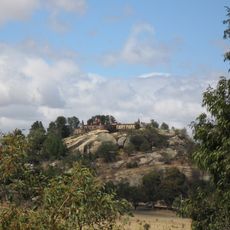
You Yangs, Granite mountain in Victoria, Australia.
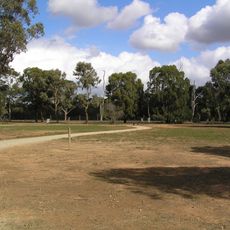
The You Yangs are granite ridges rising to 343 m at Flinders Peak, at the southern end of a main ridge that runs north-south for about 9 km, with a lower extension reaching some 15 km west. The granite formed from magma that cooled underground during the Devonian period, and slow cooling produced large white feldspar crystals visible in outcrops. Rounded tors stand above the flat Werribee Plain, behind dry grassland.
Matthew Flinders and three of his men became the first Europeans to climb the range on 1 May 1802, reaching the highest point at its southern end. He named it Station Peak; in 1912 it was renamed Flinders Peak in his honour. The granite itself solidified about 365 million years ago, long before the Werribee Plain took its present form.
The name You Yang comes from Aboriginal Wurdi Youang or Ude Youang, which may mean "big mountain in the middle of a plain", "big hill" or "bald"; the Woiwurrung word for granite, yow wong, is another possibility. The Yawangi people enlarged natural hollows in the rocks into wells that held water through dry seasons. The surrounding area was called Morong-morongoo after the murnong, or yam daisy, that grew there abundantly.
The ranges sit about 5 km west of Little River, 55 km southwest of Melbourne and 22 km north of Geelong, with the main ridge running north-south for roughly 9 km. Hovells Creek rises in the western parts, and the Little River flows around the north and east. Rainfall is as low as 450 mm a year, so the vegetation is grassland and low woodland rather than forest.
The Bunjil geoglyph was made by Andrew Rogers with 1,500 tonnes of rock, unveiled in March 2006, and has a wingspan of 100 metres. It depicts the Dreamtime creator deity as a wedge-tailed eagle and honours the local Wathaurong people.
The community of curious travelers
AroundUs brings together thousands of curated places, local tips, and hidden gems, enriched daily by 94,794 contributors worldwide.