Greater Blue Mountains Area, Protected natural area in New South Wales, Australia
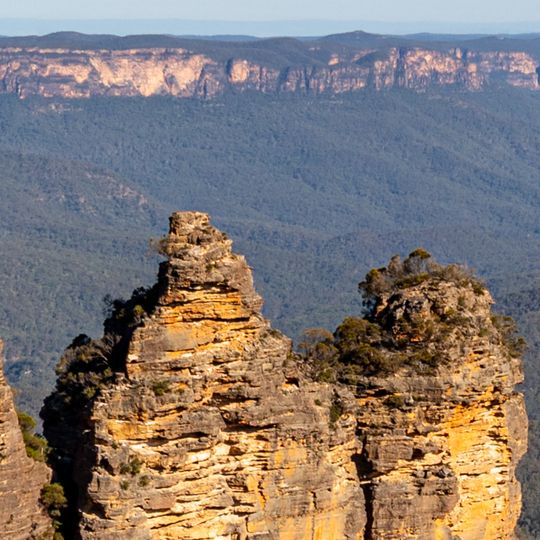
The Greater Blue Mountains Area covers 1,032,649 hectares of mostly forested sandstone plateau 60 to 180 km inland from Sydney, in two blocks holding seven national parks plus the Jenolan Caves Karst Conservation Reserve. It is not mountains in the usual sense: the plateau runs from under 100 m above sea level to 1,300 m, with basalt outcrops on the higher ridges. Tall freestanding rock pillars with pale yellow, orange and grey horizontal bands rise above a broad valley, shrubs and small trees growing on their ledges.
The Greater Blue Mountains Area was inscribed on the UNESCO World Heritage List on 29 November 2000, at the committee's 24th session in Cairns, becoming the fourth World Heritage area in New South Wales. The listing covers about 1,032,649 hectares made up of seven national parks and the Jenolan Caves Karst Conservation Reserve, with an 86,200-hectare buffer zone outside the protected area.
The name comes from the eucalypt oil that evaporates as temperatures rise and scatters blue light, so the ridges look blue from a distance. The area holds 91 eucalypt species, about 13 percent of the world total, and the Wollemi pine, a living fossil found in 1994 in remote gorges.
The area lies 60 to 180 km inland from Sydney's central business district and is split into two blocks by a transport and urban corridor, so plan travel between blocks separately. The plateau rises from under 100 m above sea level to 1,300 m at its highest point, and basalt outcrops cap the higher ridges.
The region hosts dozens of eucalyptus species whose oil vapors create the distinctive blue haze that defines these mountains. This natural coloring effect is what draws many visitors and makes the landscape instantly recognizable from afar.
The community of curious travelers
AroundUs brings together thousands of curated places, local tips, and hidden gems, enriched daily by 94,410 contributors worldwide.