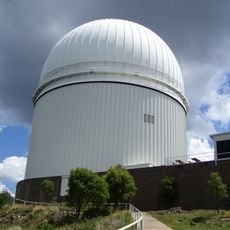
Siding Spring 2.3 m Telescope, Optical telescope at Siding Spring Observatory, New South Wales, Australia
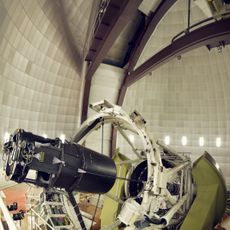
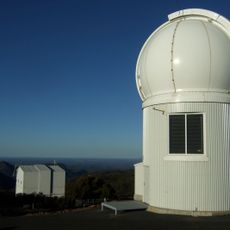
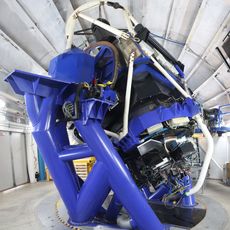
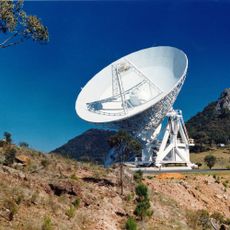
The Siding Spring 2.3 Meter Telescope is an optical instrument located at Siding Spring Observatory in New South Wales, featuring a primary mirror of 2.3 meters in diameter and a secondary mirror of 0.3 meters. Positioned at 1165 meters elevation, it sits inside a rotating structure that tracks celestial objects and contains specialized equipment for analyzing starlight.
Prime Minister Bob Hawke inaugurated the telescope on May 16, 1984, representing a major milestone for Australian astronomy research. Its opening allowed Australian scientists to conduct deeper observations of the sky and strengthened the country's standing in international astronomical work.
The 2.3 m telescope is a teaching instrument: students from ANU and other universities regularly use it to gain experience with a large scientific telescope. It also serves as a scout, doing follow-up observations of objects flagged by other detectors before larger telescopes take over. Its current instrument, WiFeS, was designed and built at the ANU's Research School of Astronomy and Astrophysics and installed in 2009.
The 2.3 m telescope is a working research instrument of the ANU Research School of Astronomy and Astrophysics, not a public visitor attraction, so access is not arranged for tourists. Its value for observers lies in the automated mode introduced in early 2023, which lets it respond instantly to alerts from other facilities. That setup suits rapid follow-up of time-varying sources such as supernovae, gamma-ray bursts and gravitational wave sources.
The mirror's diameter-to-thickness ratio is about 20:1, far thinner than conventional telescope mirrors. Combined with the altazimuth mount and co-rotating building, this light mirror lets the telescope be moved rapidly between observations. Since early 2023 the telescope has been automated, so it can respond instantly to alerts from other facilities and study time-varying sources such as supernovae, gamma-ray bursts and gravitational wave sources.
The community of curious travelers
AroundUs brings together thousands of curated places, local tips, and hidden gems, enriched daily by 94,079 contributors worldwide.