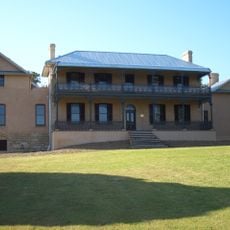
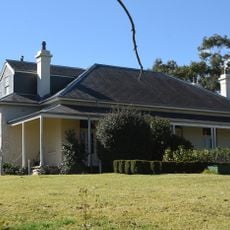
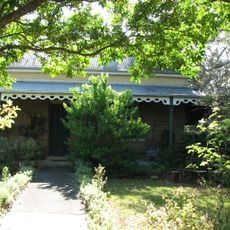
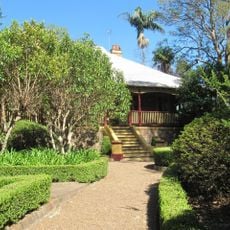
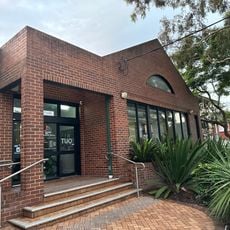
Addington House, Heritage farmhouse in Ryde, Australia.
Addington House is a rubble sandstone farmhouse at 813 Victoria Road, Ryde, built in stages between 1794 and 1841. Its core is a three-room sandstock brick cottage that James Shepherd wrapped in a six-room sandstone house around 1810, with west and east wings added later. An 1841 map shows an L-shaped plan, and brickwork from Stewart's cottage survives behind later walls.
James Stewart, an emancipated convict, held this 12-hectare grant at Kissing Point from 1794 to 1806 and built a three-room sandstock brick cottage. James Shepherd bought New Farm in 1809 for £70 and wrapped a six-room sandstone house around the cottage by 1810. Thomas Bowden, the colony's second schoolmaster, added rooms and attics in 1820 and the west wing in 1825, where he started the colony's first boarding school. The east wing followed in 1850, using Stewart's soft old bricks behind a veneer of harder brickwork.
The property is also known as New Farm, after the 12-hectare grant James Stewart farmed at Kissing Point, as Ryde was then called. In 1825 Thomas Bowden, the colony's second school master, started the first boarding school in the colony here. Later, for a short time, the house was home to Sir Henry Parkes, NSW Premier and "Father of Federation".
The house is located on Victoria Road in Ryde and can only be viewed by advance appointment, so visitors need to arrange a visit ahead of time. Tours provide better access to the rooms and collections than dropping by without planning.
The east wing added in 1850 reused bricks from James Stewart's original cottage; they were so soft they crumbled at a touch, so they were encased in harder brickwork and many coats of paint. The 1846 mortgage document is the earliest written evidence of the standing structures on the site.
The community of curious travelers
AroundUs brings together thousands of curated places, local tips, and hidden gems, enriched daily by 94,420 contributors worldwide.