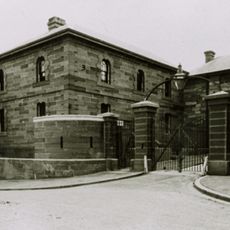
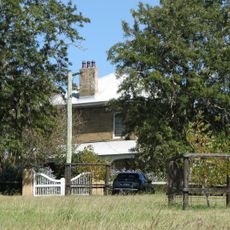
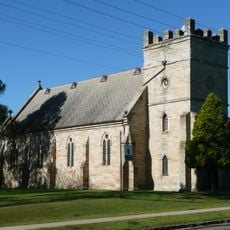
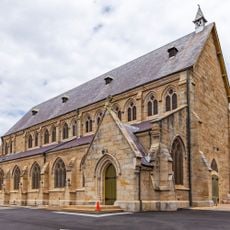
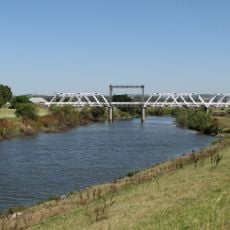
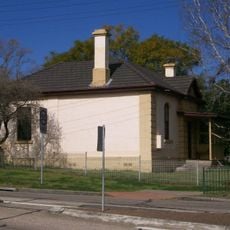
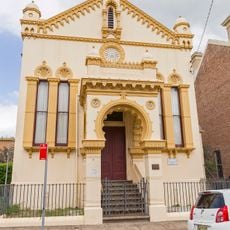
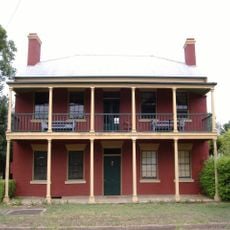
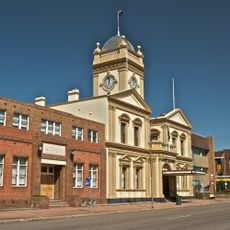
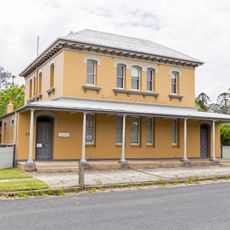
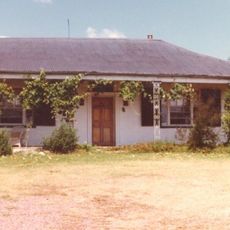
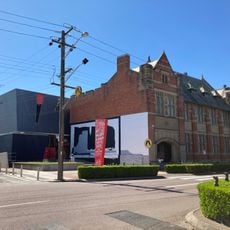
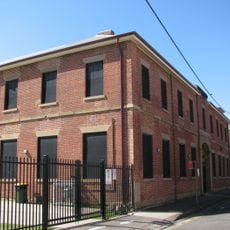
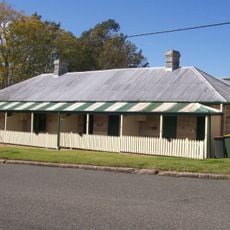
Morpeth House and Closebourne House, Heritage site in Morpeth, New South Wales, Australia.
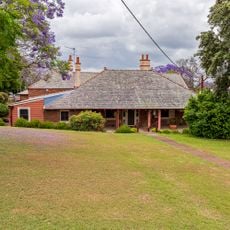
Morpeth House and Closebourne House form a heritage precinct at 365 Morpeth Road, Morpeth. Closebourne House is a two-storeyed Georgian-style house begun in the early to mid-1820s on a rise above the Hunter River, with a wide sweep of lawn and a semi-circular carriage drive. Morpeth House, later St John's College, was built by the Close family as their residence after 1849.
Lieutenant Edward Close received a grant of 2,600 acres from Governor Lachlan Macquarie around 1821. Closebourne House, a two-storey Georgian residence, was built in the early to mid-1820s on a rise above the Hunter River. In 1849 the family moved to the newly built Morpeth House, and Closebourne became the first Bishop of Newcastle's residence. Close subdivided land in the 1840s depression, selling 20 lots in 1840, 35 in 1841 and 9 in 1849.
The Hunter River at Morpeth was called Coonanbarra, and the first European landing place at Morpeth lay immediately west of the site. The Wonnaruah, linked to the Awabakal, Gringai, Darkinjung and Worimi, kept camps near reliable watercourses along the Hunter's tributaries.
The precinct is at 365 Morpeth Road, at the end of the navigable Hunter River. The two houses stand on a rise above the river, with a broad semi-circular carriage drive; one entrance was near Tank Street and Morpeth Road, the other to the west along Morpeth Road. The grounds are open to walkers.
The land was granted by Governor Lachlan Macquarie around 1821 in three lots of 1030, 1020 and 560 acres to Lieutenant Edward Close, who had arrived with the 48th Regiment of Foot in 1817. Close later subdivided the estate during a colonial depression, selling about 20 lots in 1840, 35 in 1841 and 9 in 1849.
The community of curious travelers
AroundUs brings together thousands of curated places, local tips, and hidden gems, enriched daily by 93,612 contributors worldwide.