Lockyer Creek Railway Bridge, Railway viaduct in Lockyer Valley Region, Australia
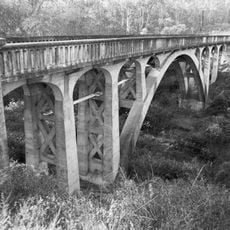
The Lockyer Creek Railway Bridge is a railway viaduct that crosses a dry gully using two reinforced concrete arch structures supported by sturdy concrete piers. The bridge sits along the Toowoomba-Helidon railway line and was built to carry rail traffic safely across the landscape.
Construction of a reinforced concrete arch bridge over Lockyer Creek began in 1909, following a similar bridge at 75 miles 48 chains. Chief Engineer William Pagan signed the design on 31 March 1910, and the bridge and its deviation opened on 21 December 1911. It replaced an earlier bridge on the Brisbane–Toowoomba Main Line to carry heavier loads.
The bridge carries a single track on a ballasted deck, and its concrete balustrade and paired spandrel columns with crossbracing can be picked out from below. It was designed by Chief Engineer William Pagan, whose signed design is dated 31 March 1910. The structure is cast-in-situ concrete throughout.
The viaduct is best accessed from local roads near the railway line, where you can see it clearly from ground level. A daytime visit works best to view the structure and the surrounding landscape in good light.
The bridge's 90-foot (27 m) main arch is one of the largest reinforced concrete spans of its type in Australia, a point noted in its Queensland Heritage Register listing of 21 October 1992. The spandrel columns above the arches are set in pairs, one for each arch rib, with concrete crossbracing between them.
The community of curious travelers
AroundUs brings together thousands of curated places, local tips, and hidden gems, enriched daily by 94,358 contributors worldwide.