Minerva Hills National Park, National park with volcanic peaks in Central Queensland, Australia.
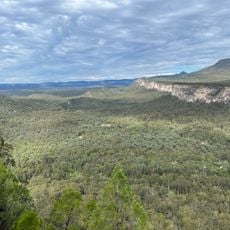
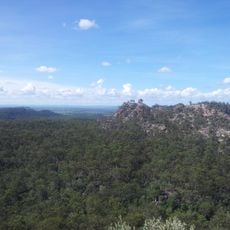
Minerva Hills National Park surrounds the old volcanoes Mount Barrambool and Mount Zamia west of Springsure. Its slopes carry open grassy woodland of mountain coolibah, silver-leaved ironbark and gum-topped bloodwood above Macrozamia and grass trees, while sheltered valleys below the cliffs hold semi-evergreen rainforest with fig trees and stinging trees. Blue-grass lawns with acacia grow on the summits.
The Minerva Hills Volcanics record Oligocene hot spot activity of the Cosgrove Hot Spot, the longest continental hot spot track on earth. The lower sequence of mafic lavas, about 70 m thick, is dated at roughly 33–34 Ma; the upper sequence of trachyte to rhyolite lavas and trachytic pyroclastics linked to plugs and domes at 28.5–27.5 Ma. The Kariai Aboriginal people lived around Springsure, leaving stone figures and rock drawings still visible today.
The area around Springsure was home to the Kariai Aboriginal people; stone figures and rock paintings attributed to them can still be seen in the district. The Virgin Rock on Mount Zamia takes its name from its outline, which from Springsure resembles the Virgin Mary cradling her child.
Access is from Springsure: 4 km west on the Dawson Developmental Road, then north onto Dendle Drive to the car park, 3 km further. From there a 1.6 km formed walking track leads to Skyline Lookout, which faces south over Mount Zamia, the Virgin Rock and the town. Camping is not permitted; other lookouts have picnic facilities.
The Minerva Hills Volcanics are a remnant of the Oligocene Cosgrove Hot Spot, which forms the longest continental hot spot track on Earth. The lower lava sequence is about 70 m thick and dates to roughly 33–34 million years ago; the upper sequence to 28.5–27.5 million years ago.
The community of curious travelers
AroundUs brings together thousands of curated places, local tips, and hidden gems, enriched daily by 94,366 contributors worldwide.