Cœur de Voh, Mangrove formation in New Caledonia
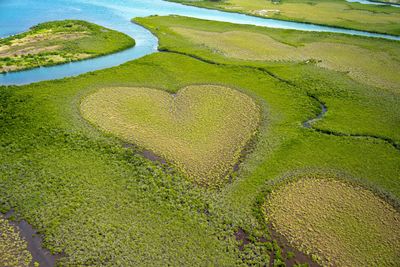
Cœur de Voh is a four-hectare clearing of bare, salt-saturated mud inside the mangrove bordering the Témala estuary in Voh, north-west Grande Terre. Seen from above it forms a stylised heart: the pale, dry centre is colonised only by grey mangrove Avicennia marina, while a denser fringe of Rhizophora stylosa, a darker green, outlines the shape. The contrast between the two greens draws the heart.
The clearing was first spotted from the air by the US military in 1942, and a first aerial photograph dates from 1943. Yann Arthus-Bertrand photographed it by helicopter in 1990; the image appeared in 1992 in Couleurs: La Nouvelle-Calédonie vue du ciel, then reached worldwide fame on the cover of La Terre vue du ciel in 1999. It was classified as heritage of the Northern Province on 13 February 2004.
The heart's outline has served since 2003 as the logo for international marketing of New Caledonian products, with the head of the Kagu, the territory's national bird, placed in its centre. New Caledonia Tourisme adopted the shape for its logo and the slogan "Pacifique au cœur", and it appears on Aircalin aircraft liveries. A 1998 photo by Mike Hosken was used on a stamp issued in August 2000.
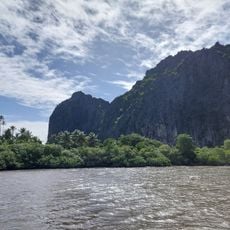
The heart lies in marshland and cannot be reached on foot; its shape is only legible from above. A natural promontory on Mont Katepaïk, reached on foot or by 4×4, gives that view, as does a flight in an ultralight or gyrocopter from Koné or Voh aerodrome. Boat excursions into the mangrove are also offered.
The heart is a "tanne inclus", a bare salt flat within the mangrove where salinity exceeds the lethal threshold, so nothing grows on it. Such clearings appear and disappear naturally; aerial and satellite photos show the heart recolonised by Avicennia marina and then stripped bare again.
The community of curious travelers
AroundUs brings together thousands of curated places, local tips, and hidden gems, enriched daily by 92,727 contributors worldwide.