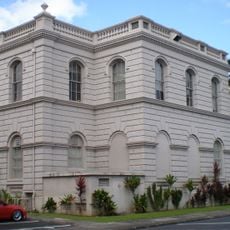
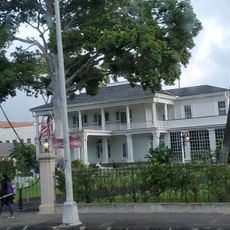
Royal Mausoleum of Hawaii, Royal burial ground in Nuuanu, Honolulu, United States.
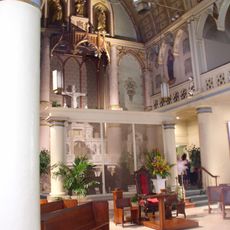
Mauna ʻAla, the Royal Mausoleum of Hawaii, stands at 2261 Nuʻuanu Avenue in Honolulu on a 2.75-acre site designed by architect Theodore Heuck. A black fence with the royal seal of the Kingdom of Hawaii surrounds the grounds. The chapel, shaped as a Latin cross, is one of the few neo-Gothic buildings in the islands; the Kalākaua tomb lies in front of it, with the Kamehameha Tomb and Wyllie Tomb nearby.
Built in 1863, the site became the final resting place for members of the Kamehameha and Kalākaua dynasties. It represents a turning point when Hawaiian royal practices shifted to incorporate Western funeral traditions.
The name Mauna ʻAla means "Fragrant Hills" in Hawaiian. The chapel, shaped as a Latin cross, is one of the few examples of Neo-Gothic architecture in the islands. The grounds are enclosed by a black fence bearing the royal seal of the Kingdom of Hawaii at the entrance.
The grounds are open to visitors during weekday hours, and it's best to plan your visit accordingly. The site requires respectful behavior as it is a sacred Hawaiian burial place.
Mauna ʻAla was removed from United States public lands by a joint resolution of Congress in 1900, two years after Hawaii's annexation by the Newlands Resolution under President William McKinley. The 2.75-acre grounds were designed by architect Theodore Heuck, and the chapel was listed on the National Register of Historic Places on August 7, 1972.
The community of curious travelers
AroundUs brings together thousands of curated places, local tips, and hidden gems, enriched daily by 93,024 contributors worldwide.