Ojuela Bridge, Suspension bridge in Mapimí, Mexico.
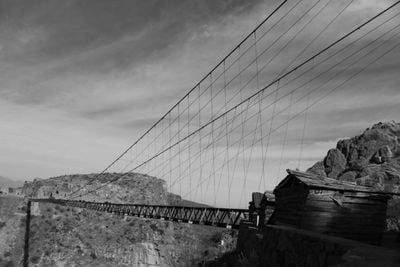
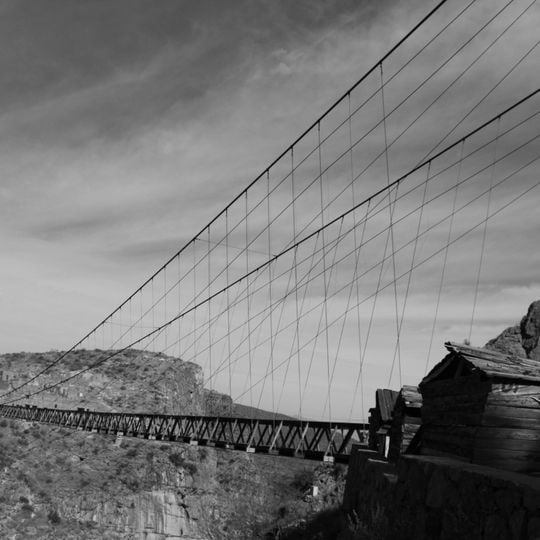
Ojuela Bridge is a steel suspension bridge at the former Ojuela mining settlement in Mapimí, Durango. Two thick main cables run diagonally down to the deck, with vertical suspender ropes hanging from them. The deck is a long horizontal truss of crossed metal bars in an X-pattern, with dark rectangular blocks set at intervals beneath it. The bridge spans a deep canyon on rocky terrain.
Mining at Ojuela dates to the late 16th century, and the Mapimí district was established in 1598. The Compañía Minera de Peñoles acquired the property in the 1890s and built the bridge to carry mine cars across the canyon. The construction date is disputed: a plaque commemorates 1892–1992, but engineering reports and municipal records point to 1898–1899, with completion in November 1899 and operation around 1900.
The bridge linked the Ojuela mine to Mapimí and the Peñoles company's other facilities by rail; ore moved from the workings toward processing and smelting plants. The settlement beside it grew into a company town with extensive underground workings. The name Ojuela is still attached to the site, and the bridge is now crossed only on foot.
The bridge is accessible during daylight hours and parking is available at the entrance. Visitors should bring water and wear sturdy shoes as the terrain is uneven and the area can be very hot.
The bridge's construction date is disputed: a plaque long displayed on it commemorated 1892–1992, but a 1908 report in The Engineering and Mining Journal by Claude T. Rice states the John A. Roebling Company built it in 1899, and a Mapimí municipal history gives completion in November 1899.
The community of curious travelers
AroundUs brings together thousands of curated places, local tips, and hidden gems, enriched daily by 92,858 contributors worldwide.