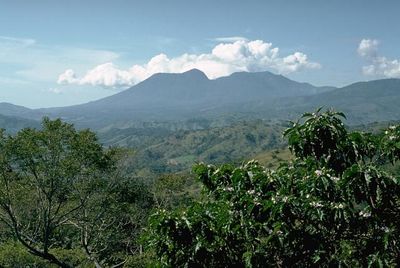
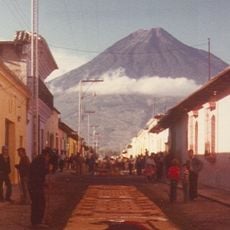
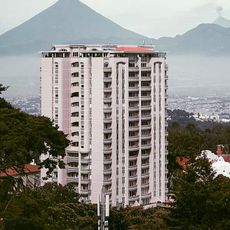
Tecuamburro, Volcanic summit in Santa Rosa, Guatemala.
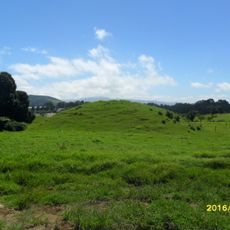
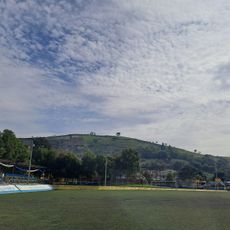
Tecuamburro is a dormant volcano in Santa Rosa that rises to approximately 2000 meters. Its slopes are covered in dense forest of pine and cypress trees that extend from the lower areas to the higher elevations.
Tecuamburro is an andesitic stratovolcano that formed about 38,000 years ago inside a horseshoe-shaped caldera. That caldera came from a structural failure in an older stratovolcano, Miraflores, roughly 100,000 years old. Its last eruption is dated to around 960 BCE, so it is classified as dormant rather than extinct.
The volcano's name comes from the Nahuatl words for "owl" and "hill", a reminder that Nahuatl-speaking Pipil communities lived in this part of Santa Rosa. The crater lake, hot springs and mudpots at the top are the features people in Guazacapán and nearby villages associate with the mountain; the surrounding land is farmed on its lower slopes.
The summit holds an acidic crater lake ringed by hot springs, fumaroles and boiling mudpots, so the ground near the rim is unstable and the sulphur fumes are strong. Approach from Guazacapán, about 10 km south of the volcano, and plan the climb for the dry season. Laguna de Ixpaco, a crater lake, lies just north of the volcano.
Tecuamburro's summit crater holds an acidic lake, and around it cluster hot springs, fumaroles and boiling mudpots. The volcano sits inside the horseshoe-shaped caldera of the older Miraflores stratovolcano, roughly 100,000 years old, which failed structurally and left the open bowl the younger cone grew in.
The community of curious travelers
AroundUs brings together thousands of curated places, local tips, and hidden gems, enriched daily by 92,710 contributors worldwide.