Menard-Hodges Site, Archaeological mound complex in Arkansas County, United States.
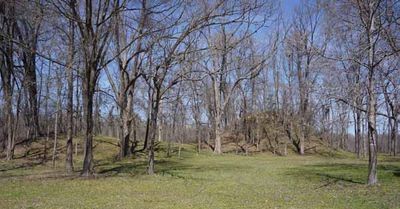
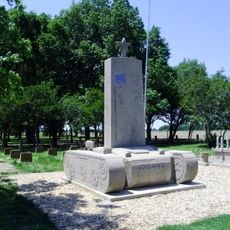
The Menard-Hodges Site (3AR4) in Arkansas County holds two large platform mounds plus several house mounds, the type site of the protohistoric Menard phase of Mississippian culture. Its most unusual feature is Mound A, a conical mound built in two stages. The Menard Mound takes its name from Frank Menard, on whose farm it was found.
Occupation at the Menard–Hodges site reaches back to the Baytown Period (300–700 CE) and continued into the 16th-century European contact era. The Menard Mound takes its name from Frank Menard, on whose farm it was found. James A. Ford excavated the site in 1958, uncovering extended, flexed and secondary burials oriented in many directions. It was listed on the National Register in 1985 and named a National Historic Landmark in 1989.
The site is identified with Osotouy (Ossoteoue), one of four Quapaw villages recorded by French explorers in the late 17th century, alongside Kappa, Touriman and Tonginga. Kappa lay on the east bank of the Mississippi, the other three on the west bank in or near present-day Desha County. The name Menard Mound comes from Frank Menard, on whose farm the mound was found.
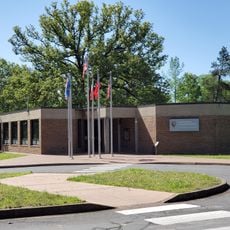
The site can be visited as part of a protected national memorial where you can walk among the mounds and view them from different angles. The open landscape makes it easy to understand the layout and how the ancient people organized this space.
The most unusual feature is Mound A, a conical mound built in two stages, unlike the flat-topped platform mounds beside it. Excavations by James A. Ford in 1958 found burials in extended, flexed and secondary interments, oriented in many different directions across the site.
The community of curious travelers
AroundUs brings together thousands of curated places, local tips, and hidden gems, enriched daily by 93,847 contributors worldwide.