Red Mountain Expressway Cut, Geological formation near Birmingham, Alabama
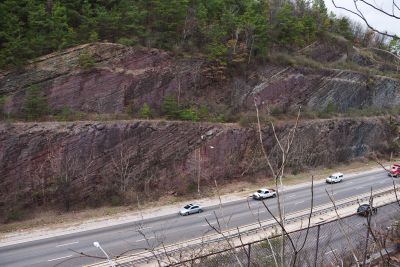
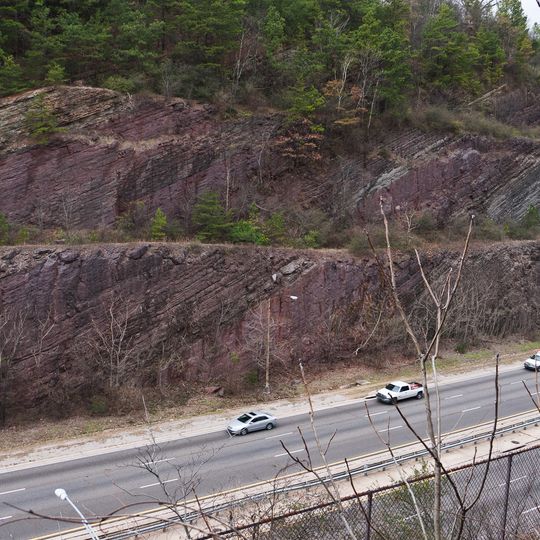
Red Mountain Expressway Cut is a section of Red Mountain blasted and removed in the 1960s to let the Red Mountain Expressway enter downtown Birmingham, Alabama. The resulting cut exposes geological strata spanning 150 million years within 650 feet (200 metres) of exposure, including the red ore seam that spurred Birmingham's development.
The rock wall was created during the 1960s construction of the Red Mountain Expressway, which was designed to connect Birmingham with southern suburbs. This highway project unintentionally exposed geological layers that later proved valuable to scientists studying the region's deep history.
The cut is a roadside geological exposure rather than a staffed centre: its rock walls are visible from the expressway and are studied by geology classes and fossil collectors. The trilobite Acaste birminghamensis was first collected from exposures on Red Mountain and published in May 1972, named for the city.
The cut lies along the Red Mountain Expressway, which carries U.S. 31 south and U.S. 280 southeast; drivers pass directly through the exposed rock walls. The site is a road cut rather than a trail, so viewing is from the highway or roadside; no walkway is documented in the sources.
The trilobite Acaste birminghamensis was first collected from exposures on Red Mountain and published in May 1972, named for Birmingham. It is a phacopsid trilobite from the middle Llandovery epoch of the Lower Silurian.
The community of curious travelers
AroundUs brings together thousands of curated places, local tips, and hidden gems, enriched daily by 92,880 contributors worldwide.