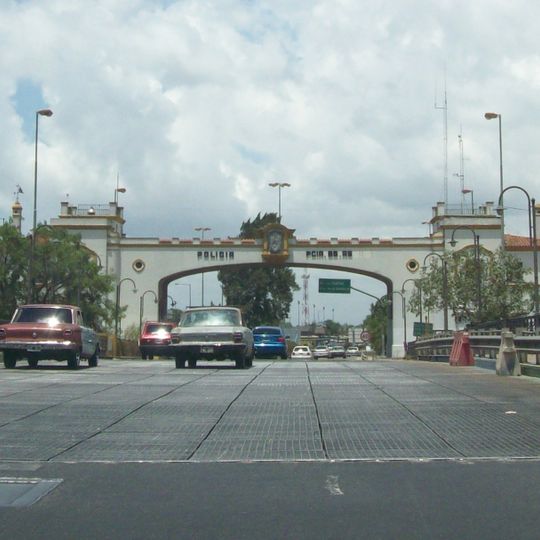
La Noria Bridge, Road bridge at the Buenos Aires–La Matanza border, Argentina
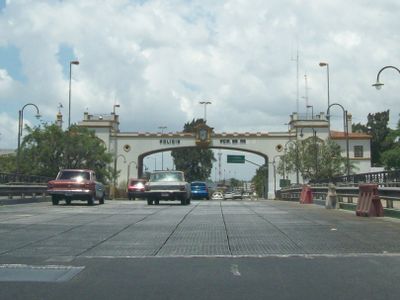
La Noria Bridge spans the Riachuelo River and links Buenos Aires City to the surrounding province with a steel structure divided into multiple sections. The crossing operates with two parallel roadways that handle traffic flowing in opposite directions simultaneously.
The crossing was long known as Paso de Zamora, a ford chosen for its shallow water and firm tosca bottom, and later as Paso de la Noria after Gregorio Rodríguez's horse-driven water wheel. A bridge was built there in 1905 to link the farms and ranches on both banks of the Riachuelo. The current structure, designed by Atilio Ottanelli and built by the Dirección Nacional de Vialidad under engineer José C. Álvarez, was begun in 1935 and finished in 1944, 850 m southwest of the old one, whose demolition followed.
This crossing marks the southwestern border of Buenos Aires City and serves as a tangible divide between the urban center and the province. Residents and commuters experience it as a threshold moment during their daily journeys across jurisdictions.
The bridge accommodates heavy daily traffic from commuters moving between both administrative areas. Travel during early morning or late evening hours typically offers smoother passage with lighter congestion.
The name comes from a horse-driven water wheel (noria de caballo) that stood beside the Riachuelo on Gregorio Rodríguez's chacra, which gave the old Paso de la Noria its name. The 1905 bridge was built to link the estancias and farms on both banks, when part of Villa Riachuelo still belonged to the province rather than the capital.
The community of curious travelers
AroundUs brings together thousands of curated places, local tips, and hidden gems, enriched daily by 92,957 contributors worldwide.