Cataract Gorge, Nature reserve gorge in Launceston, Tasmania, Australia.
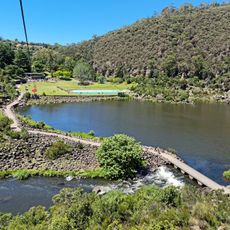
Cataract Gorge is a river gorge near Launceston where the South Esk River cuts through forested terrain, creating a deep canyon flanked by steep rocky walls. The valley extends across several kilometers and features walking paths, gardens, and areas of native forest interspersed throughout.
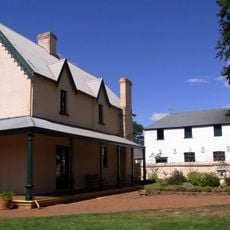
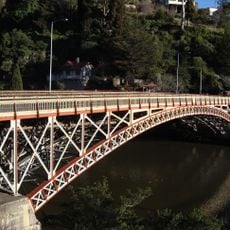
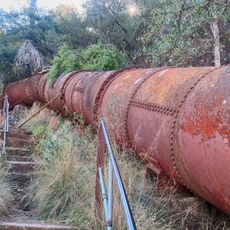
William Collins, aboard the Lady Nelson, discovered the gorge's entrance in 1804. In the 1890s volunteers built the King's Bridge–Cataract Walk along the north bank; a toll house where pedestrians paid to enter still stands near King's Bridge. The Duck Reach power station, completed in 1895, first lit Launceston's streets.
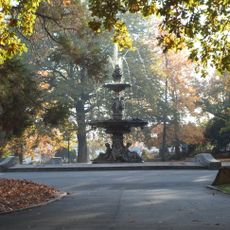
The King's Bridge-Cataract Walk along the north bank was built by volunteers in the 1890s, and the original toll house where pedestrians paid to enter still stands near King's Bridge. The northern Cliff Grounds are a landscaped Victorian garden with ferns, exotic plants and free-roaming peacocks.
Access to the gorge is easiest via the marked walking trails such as the Cataract Walk and Zig Zag Track, which start near Kings Bridge and lead through the valley. The terrain varies from gentle paths to steeper sections, so sturdy footwear and allowing time to explore at a relaxed pace is recommended.
The chairlift, built in 1972, has a total span of 457 m, and its longest single span between towers is 308 m, the longest such span in the world. It crosses above the First Basin, giving riders a view of the pool, the Alexandra Suspension Bridge and the South Esk River below.
The community of curious travelers
AroundUs brings together thousands of curated places, local tips, and hidden gems, enriched daily by 93,804 contributors worldwide.