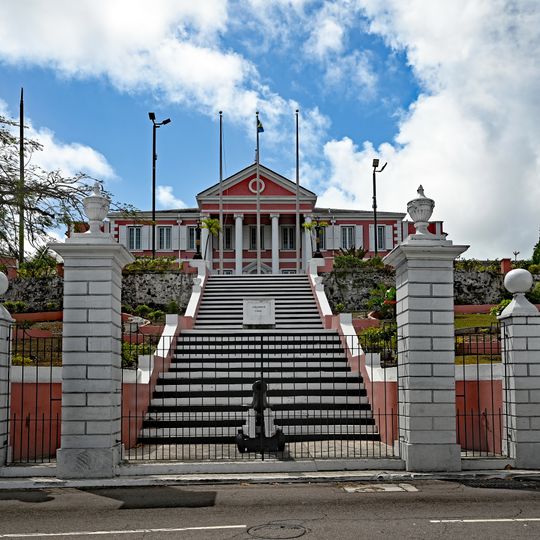
Government House, The Bahamas, Colonial government residence on Mount Fitzwilliam, Nassau, Bahamas
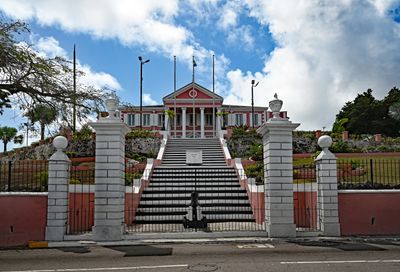
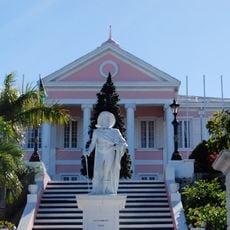
Government House is a two-storey stuccoed coral-rock building on Duke Street, on Mount Fitzwilliam. Its salmon-pink walls carry white trim, louvred wood shutters and a grey roof. The central section projects under a triangular pediment with a circular white-ringed opening, held by four white Ionic columns; the wings have white-framed windows with dark green shutters. A staircase of alternating black and white steps with white balustrades and urn-topped pillars descends to a black anchor.
The residence was built between 1803 and 1806, replacing an earlier structure from 1737. After independence in 1973, it became the official residence of the Governor General.
A 12-foot statue of Christopher Columbus stands at the harbourside entrance, placed there by Governor James Carmichael Smyth in 1830. Reportedly designed in London by an aide to Washington Irving, it is labelled because, as observers noted, the swaggering figure with slouch hat and toga would otherwise not be recognised as Columbus.
Government House stands on Duke Street on Mount Fitzwilliam, above the town centre and overlooking the harbour. The building is viewed from public areas outside; tours of the interior can be arranged. The site is reached by climbing a wide staircase of alternating black and white steps between white balustrades, with a black anchor resting at its base.
The 12-foot Columbus statue at the harbourside entrance was reportedly designed in London by an aide to Washington Irving, the American novelist and Columbus biographer. Governor James Carmichael Smyth placed it there in 1830; one observer noted it is "notable for its size rather than its artistry", and that only its label reveals the swaggering, piratical figure is meant to be Columbus.
The community of curious travelers
AroundUs brings together thousands of curated places, local tips, and hidden gems, enriched daily by 93,845 contributors worldwide.