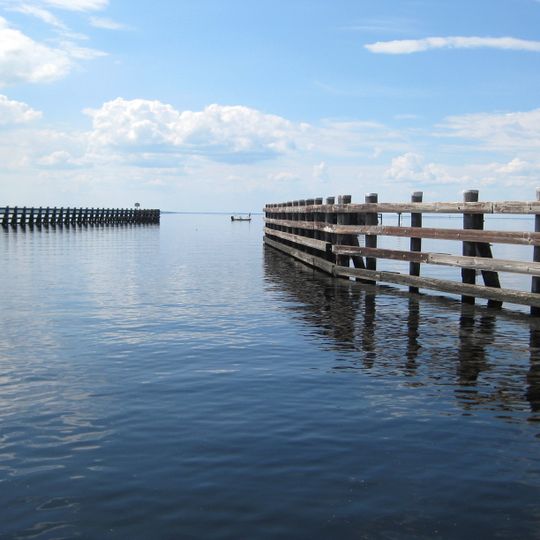
Lake George, Natural lake in Central Florida, United States.
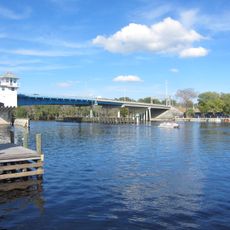
Lake George is a broad, shallow brackish lake on the St. Johns River in Florida, about 22 km long and 10 km wide with an average depth of 2.5 m. It is the state's second-largest lake after Lake Okeechobee, covering 186.16 km². Drayton Island is its largest island, and the Ocala National Forest borders its eastern shore.
Pedro Menéndez de Avilés, Spanish governor of Florida, explored the St. Johns River and visited the lake in spring 1596. In 1765 the royal botanist John Bartram, appointed by King George III, explored the river and named the lake after his king. During World War II the U.S. Navy built bomb targets in the lake and nearby Crescent Lake, and the bombing range remains under Naval Air Station Jacksonville.
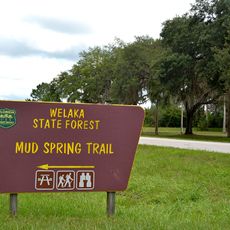
The name Welaka comes from the Muskogee language of the Seminole, in which it means "chain of lakes" and was the name for the St. Johns River. The lake is also called Lake Welaka, so both names remain in use.
The St. Johns River leaves the lake at its north end at Rocky Point, and Salt Cove just west of there takes the flow from Salt Creek. Steamboats from Jacksonville once looped the lake counterclockwise, stopping first at Lisk Point, named for a Dr. Lisk who built a house nearby. The eastern shore borders the Ocala National Forest.
Saltwater springs feed into the lake, making parts of it brackish and creating an unusual mix where freshwater and marine life coexist. This blend allows creatures like blue crabs and stingrays to thrive alongside typical freshwater fish.
The community of curious travelers
AroundUs brings together thousands of curated places, local tips, and hidden gems, enriched daily by 92,679 contributors worldwide.