Susina Plantation, Greek Revival plantation in Grady County, Georgia, United States.
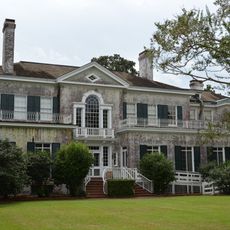
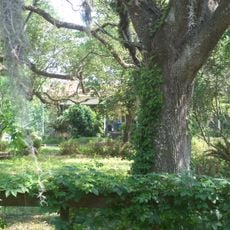
Susina Plantation is a Greek Revival house and dependencies on 140 acres near Beachton, about 15 miles southwest of Thomasville. The main house sits on a knoll among live oaks and magnolias. Its Ionic portico is carried by four two-story fluted, tapered round columns and spans about three-fourths of the facade. The house was built of heart-pine cut on the property, with clapboard siding set flush under the portico to resemble stone.
Edward Blackshear settled the land around 1822; his sons James Joseph and Thomas Edward later amassed about 4,815 acres. Circa 1841 James Joseph commissioned Bristol-born architect John Wind to design the house, originally called Cedar Grove. James Joseph died in a cotton press accident on November 3, 1843, before completion, and his widow Harriet finished it. In 1887 Dr. John Metcalfe of New York bought the property as a hunting lodge and renamed it Susina.
The property reflects the transformation of Southern agricultural estates, transitioning from cotton production to private hunting grounds in the early 1900s.
The estate sits on a secluded property southwest of Thomasville along Meridian Road and functions as a private residence. You can view it from the road, but access to the interior or grounds is not available to the public.
Susina was acquired in 2000 by Randall and Marilynn Rhea of Atlanta, who hired Thomasville contractor Terrell Singletary to repair the main house and four dependencies. The house was chosen for the cover image of two books on antebellum houses.
The community of curious travelers
AroundUs brings together thousands of curated places, local tips, and hidden gems, enriched daily by 93,729 contributors worldwide.