Jordan–Hare Stadium, College football stadium in Auburn, Alabama.
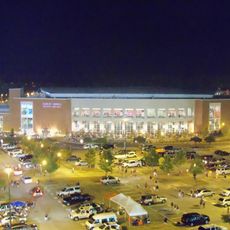
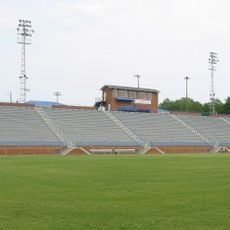
Jordan-Hare Stadium is a major college football venue in Auburn featuring a natural grass field surrounded by multilevel seating sections with blue seats. The structure accommodates around 87,000 spectators arranged across a massive concrete framework.
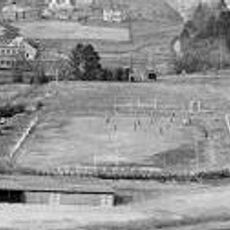
Auburn Stadium hosted its first game on November 10, 1939, between Auburn and Georgia Tech freshmen, and was dedicated on Thanksgiving Day, November 30, 1939, before a 7–7 varsity tie with Florida. The west grandstand held 7,500 seats, though the full original capacity was about 15,000. Renamed Cliff Hare Stadium in 1949 after expansion to 21,500, it became the first US stadium named for an active coach when Shug Jordan's name was added in 1973.
The stadium's name honors Ralph "Shug" Jordan, the coach with the most wins in Auburn history, and Cliff Hare, a member of Auburn's first football team and dean of the School of Chemistry. In 1973 Jordan's name was added while he was still coaching, the first US stadium named for an active coach. Ten large murals by artist Michael Taylor on the east exterior, updated in 2006 and 2011, depict great players, teams and moments.
The facility has multiple entrance gates, food vendors, and restroom facilities throughout the seating areas. Visitors should arrive early to secure parking and explore the different sections before the game begins.
The east exterior carries ten large murals by artist Michael Taylor, commissioned in 1998 and updated in 2006 and 2011 to show Auburn's greatest players, teams and moments. In 1973 the stadium became the first in the United States named for an active coach, Shug Jordan.
The community of curious travelers
AroundUs brings together thousands of curated places, local tips, and hidden gems, enriched daily by 92,726 contributors worldwide.