Polio Hall of Fame, Memorial sculpture at Roosevelt Warm Springs Institute, Georgia, United States.
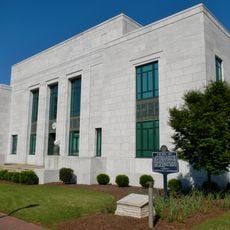
The Polio Hall of Fame is a set of seventeen bronze busts, green with patina, fixed directly to a wall of pale stone panels outside Founders' Hall at the Roosevelt Warm Springs Institute for Rehabilitation in Warm Springs, Georgia. The heads, sculpted by Edmond Romulus Amateis, are set in an irregular linear pattern, and a black cast-metal bench with a pierced back stands below them.
Sculptor Edmond Romulus Amateis created the seventeen bronze busts for the Georgia Warm Springs Foundation, and the monument was unveiled on January 2, 1958, marking the 20th anniversary of the National Foundation for Infantile Paralysis. Eleanor Roosevelt attended on behalf of her late husband, and almost all living scientists depicted were present.
The busts honor both scientists and the organizers who made their work possible, with Franklin D. Roosevelt and Basil O'Connor as the only non-scientists represented. This makes the site one of the few memorials that places medical research and public leadership side by side.
The seventeen busts are mounted directly on the exterior wall of Founders' Hall, with no explanatory plaques between them. The order is not strictly chronological after the first four European pioneers, so the sequence itself does not tell the story. The black cast-metal bench below the wall offers a place to sit and compare the faces.
Hilary Koprowski, who developed the first effective live polio vaccine, is absent from the wall; his bust was never added. The first four busts honor European pioneers: Jakob Heine of Germany, Swedes Karl Oskar Medin and Ivar Wickman, and Austrian Nobel laureate Karl Landsteiner. The remaining eleven scientists are American.
The community of curious travelers
AroundUs brings together thousands of curated places, local tips, and hidden gems, enriched daily by 93,036 contributors worldwide.