Point Reyes Lighthouse, Maritime lighthouse at Point Reyes National Seashore, California, United States.
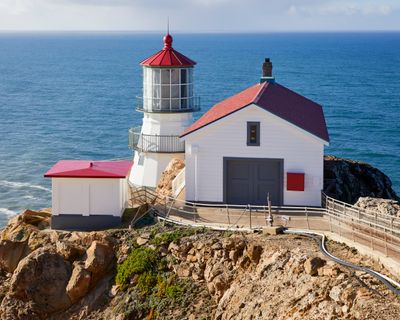
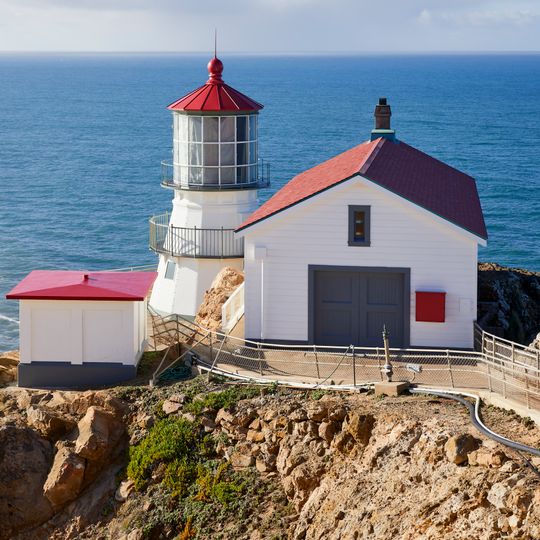
Point Reyes Lighthouse is a sixteen-sided tower of forged iron plates bolted to the rock, standing on a ledge blasted level 90 metres below the cape's top. Its lantern sits 11 metres above the ground, with the focal plane 88 metres above sea level. A white cylindrical tower with a red roof and a circular gallery with black railing rises from a white base; a small white building with a red roof adjoins it, and a larger white building with a red gable roof and grey chimney stands to the right.
A lighthouse was assigned to Point Reyes in 1855 after 60 shipwrecks near the cape, but a land-price dispute with the owners delayed construction for fifteen years. The 2,700-kilogram Fresnel lens and mechanical parts were made in France in 1867 by Barbier and Fenestre, shipped to Drakes Bay and hauled up the 180-metre rock plateau by ox cart. Dynamite levelled a site 90 metres below the cape top, and the light was first lit on 1 December 1870.
The lighthouse appears as Spivey Point in John Carpenter's 1980 film The Fog, where Adrienne Barbeau's radio host broadcasts from the tower. A museum opened inside the lighthouse on 15 August 1977, presenting the keepers' daily life. Weldon Kees wrote the poem "The Exposed Reef" about the site and made a documentary with William Heick in 1954-55.
Access is by more than three hundred steps, which close during high winds or thick fog. Visitors should allow time for the climb down and back up, pausing on the return.
The 1906 San Francisco earthquake shifted the Point Reyes peninsula more than five metres north within a minute, yet the lighthouse survived undamaged; only the Fresnel lens was lifted from its mounting, and the light was working again after a thirteen-minute repair.
The community of curious travelers
AroundUs brings together thousands of curated places, local tips, and hidden gems, enriched daily by 94,695 contributors worldwide.