San Francisco–Oakland Bay Bridge, Double-decker suspension bridge in San Francisco Bay, United States
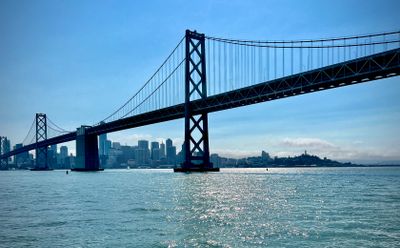
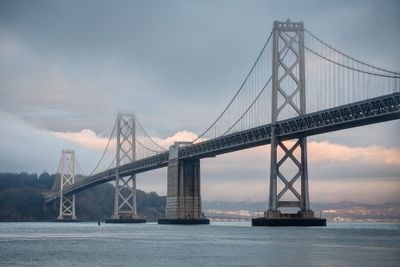
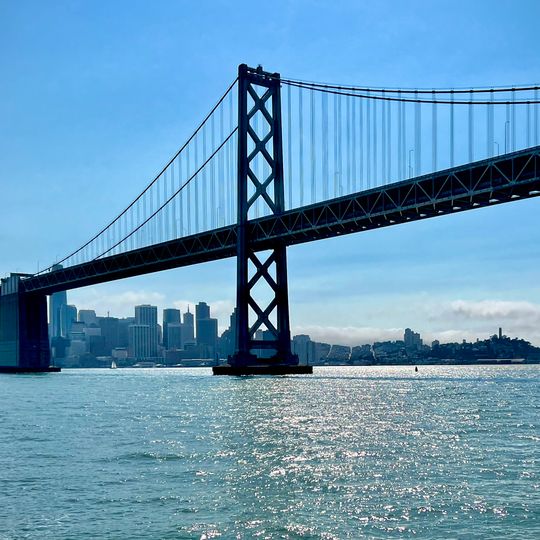
The San Francisco–Oakland Bay Bridge spans San Francisco Bay in two sections joined at Yerba Buena Island. The western section is a double-deck suspension bridge with two complete spans meeting at a central concrete anchorage; the eastern section, rebuilt in 2013, is a single-deck self-anchored suspension bridge. A 540-foot tunnel crosses the island's central hill.
The bridge was conceived during the Gold Rush, and Emperor Norton called for a suspension link in the 1870s. Congress approved the project in 1931, work began on 9 July 1933, and the bridge opened on 12 November 1936, six months before the Golden Gate Bridge. It cost $77.6 million and 24 workers died during construction.
The name refers to the two major cities it connects across opposite shores of the bay. Locals often call it simply the Bay Bridge to distinguish it from the Golden Gate crossing.
The western span carries westbound traffic on its upper deck and eastbound on its lower deck; pedestrians and bicycles are barred, though a Caltrans bicycle shuttle runs between Oakland and San Francisco at commute hours. The Oakland toll plaza has eighteen lanes, with two bus-only lanes bypassing the booths on the north side.
Rock and rubble dug out for the 160 m Yerba Buena Tunnel was partly used to build Treasure Island, the artificial island next to the bridge. The tunnel carries the roadway through the island's central hill.
The community of curious travelers
AroundUs brings together thousands of curated places, local tips, and hidden gems, enriched daily by 92,077 contributors worldwide.