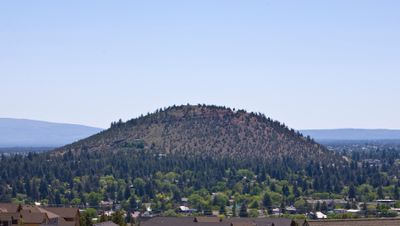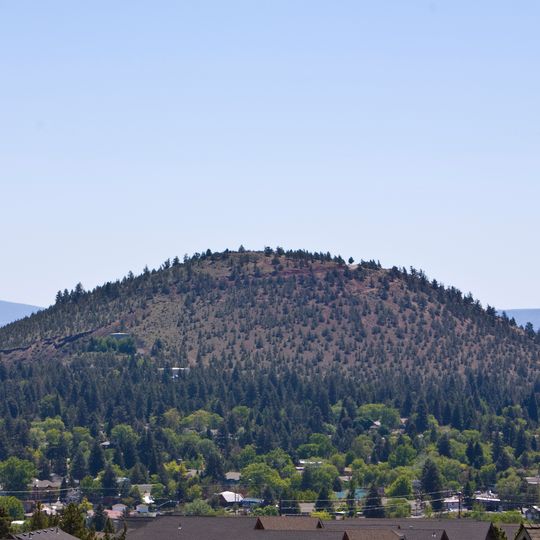
Pilot Butte, Extinct volcano in Bend, Oregon.
Pilot Butte is a Pleistocene cinder cone of basaltic andesite rising nearly 500 feet (150 m) above the plains within Bend, with a summit listed at 4,141 feet (1,262 m) by the Geographic Names Information System. Its lower southwest flank carries white rhyolitic tephra, and its light-colored soil holds ash from the Mount Mazama eruption that formed Crater Lake.
Pilot Butte is a Pleistocene cinder cone, dated by one study to about 188,000 ± 42,000 years ago. About 78,000 years ago, basalt lava flows from Newberry Volcano surrounded the butte and filled the Deschutes riverbed, forcing the river into a new channel to the west. The butte was donated to the State of Oregon in September 1928 by F. R. Welles, Kempster B. Miller and Charles A. Brown, in memory of Terrence Hardinton Foley.
The butte's name comes from Thomas Clark, who in 1851 led the first party of European settlers to camp on the future site of Bend and named the landmark. It was long known as Red Butte. Every Independence Day the city launches fireworks from the butte, and a memorial tablet at the summit honours Terrence Hardinton Foley, an Elks Lodge leader who died in a 1926 car accident.
Several trails of varying difficulty lead to the summit, with some paved routes being easier to walk while others offer more natural paths. Bring sturdy shoes and plenty of water, especially during warmer weather.
Pilot Butte is one of only six U.S. cities with a volcano inside its city limits, alongside Mount Tabor in Portland, Diamond Head in Honolulu and Pilot Knob in Austin. The summit park was donated to Oregon in 1928 by three business partners in memory of Terrence Hardinton Foley, a local Elks Lodge leader killed in a 1926 car accident; a memorial tablet honours him.
The community of curious travelers
AroundUs brings together thousands of curated places, local tips, and hidden gems, enriched daily by 94,445 contributors worldwide.