Fremont Bridge, Tied-arch road bridge in Portland, United States
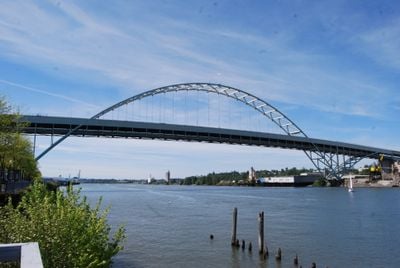
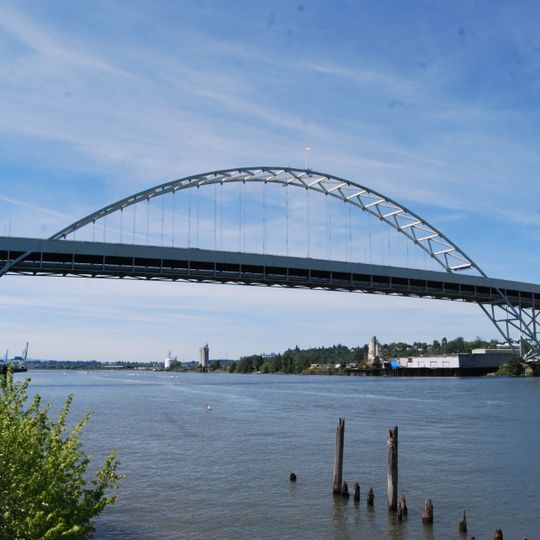
The Fremont Bridge is a road bridge with two decks that carries traffic across the Willamette River between downtown Portland and the northern district. The structure uses a tied-arch design to support the traffic flowing in both directions.
Construction began in March 1968, and the bridge opened on November 15, 1973, at a cost of $82 million. The Portland Art Commission was involved in the design from the start, after public dissatisfaction with the Marquam Bridge. The design followed the 1964 Port Mann Bridge in British Columbia. In 1971 a 1.8 m crack in a main girder required a $5.5 million repair.
The Portland Art Commission influenced the bridge design to create a structure that would better complement the city landscape than its predecessor.
The bridge carries four lanes on each of its two decks: the upper deck is signed westbound on US 30 and southbound on I-405, the lower deck eastbound on US 30 and northbound on I-405. Each deck is 20.7 m wide, with 3.66 m lanes and a 3 m shoulder on both sides. The structure clears the Willamette River by 53.3 m.
On March 16, 1973, the 6,000-short-ton steel arch span was lifted 170 feet (52 m) by 32 hydraulic jacks, a feat listed at the time in the Guinness Book of World Records as the heaviest lift ever completed. The span had been assembled at Swan Island Industrial Park and floated 1.7 miles downstream on a barge.
The community of curious travelers
AroundUs brings together thousands of curated places, local tips, and hidden gems, enriched daily by 93,796 contributors worldwide.