Bainbridge Island Japanese American Exclusion Memorial, National memorial on Bainbridge Island, Washington, United States
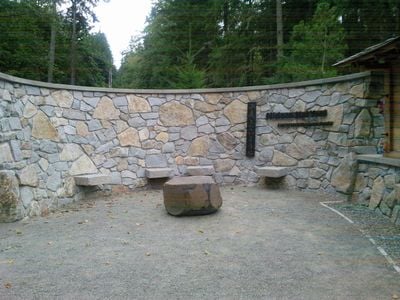
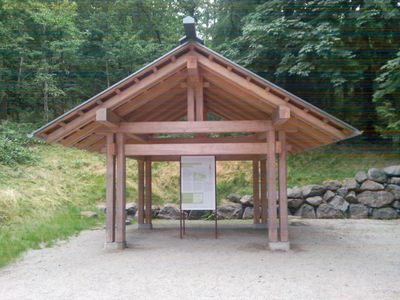
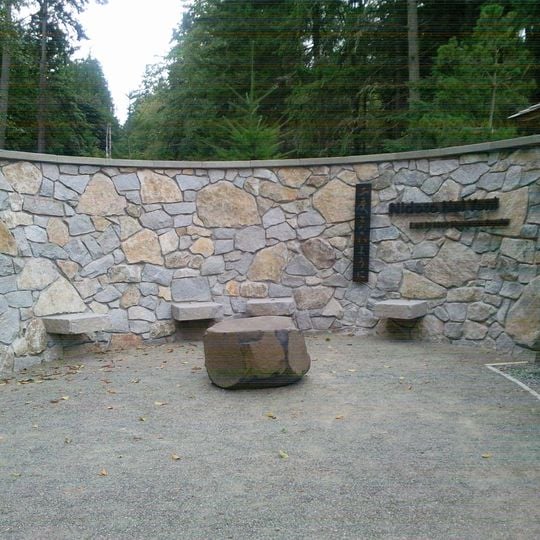
The Bainbridge Island Japanese American Exclusion Memorial is an outdoor exhibit on the south shore of Eagle Harbor, opposite Winslow. Its centerpiece is a curved story wall of rough gray, tan and brown stones, with a dark central pillar bearing a metal inscription and three stone benches set into its base. A large rough-hewn stone with a flattened top stands in front, and a wooden pavilion with a steep gabled roof and six posts stands nearby.
Bainbridge Island was the first location in the United States where Japanese Americans were forced to leave their homes under Executive Order 9066 in March 1942. This forced removal set a precedent that led to widespread displacement of Japanese American families across the nation during World War II.
The site honors the Japanese American community through its design, which emphasizes individual human stories rather than abstract historical facts. Visitors can encounter personal narratives and names displayed throughout, connecting the memorial's purpose directly to real people and their families.
The memorial is accessible daily from sunrise to sunset and sits in a quiet waterfront location that is easy to walk around. Guided tours are available through the Bainbridge Island Historical Museum for those wanting more detailed information about the site.
The memorial is a unit of Minidoka National Historic Site in Idaho, though it stands in Washington. Its mission phrase, Nidoto Nai Yoni, means "Let It Not Happen Again". The story wall was designed by architect Johnpaul Jones, who planted native sword fern, mahonia, salal and shore pine around it.
The community of curious travelers
AroundUs brings together thousands of curated places, local tips, and hidden gems, enriched daily by 94,629 contributors worldwide.