Wedgwood Rock, Glacial erratic in Wedgwood, Seattle, United States
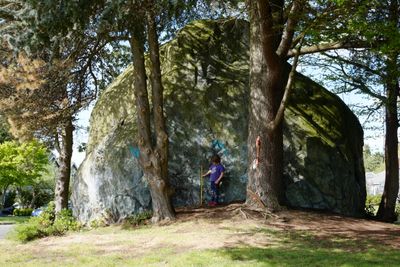
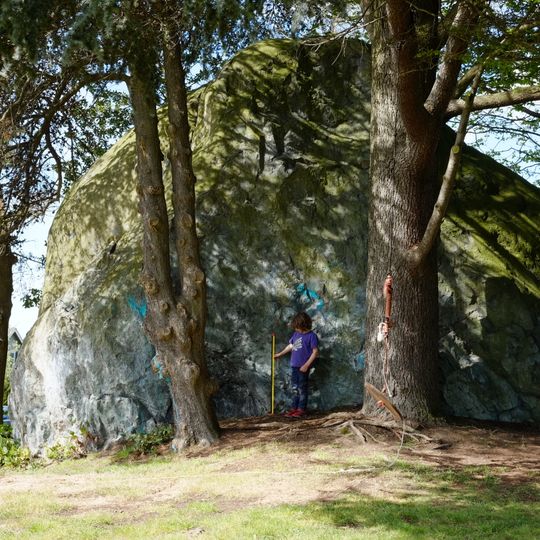
Wedgwood Rock is a glacial erratic on 28th Avenue NE near NE 72nd Street in Seattle's Wedgwood neighborhood. It stands 19 feet high, measures 80 feet in circumference, and has an estimated mass of 700 metric tons. Its mineral composition matches Mount Erie on Fidalgo Island, 55 miles north.
The rock is a glacial erratic carried to this site by the Puget Lobe of the Cordilleran Ice Sheet during the Vashon Glaciation more than 14,000 years ago. Its mineral composition matches Mount Erie on Fidalgo Island, 55 miles north. In 1881 it stood on William Weedin's 160-acre farm and was called Lone Rock; by the early 20th century it was known as Big Rock.
Before the Wedgwood neighborhood existed, the rock was called Lone Rock, then Big Rock. Members of the Mountaineers Club trained here with the Miller family's permission; Edmond S. Meany brought University of Washington students to study glacial landforms, and Wolf Bauer and REI founder Lloyd Anderson taught Boy Scouts to climb. Fred Beckey and Jim Whittaker, later the first American atop Everest, began training on it.
The rock is accessible from the street and visible at any time of day. Climbing is prohibited by city regulations, so visitors can enjoy viewing and photographing it from the surrounding area.
Scientists traced the boulder's origin to Mount Erie, located about 55 miles to the north, by studying its mineral composition. This discovery revealed how powerful glacial forces were in moving such massive stones across great distances during the ice age.
The community of curious travelers
AroundUs brings together thousands of curated places, local tips, and hidden gems, enriched daily by 94,628 contributors worldwide.