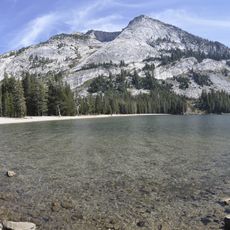
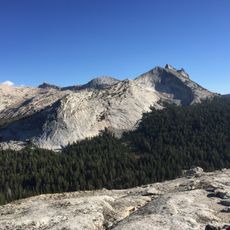
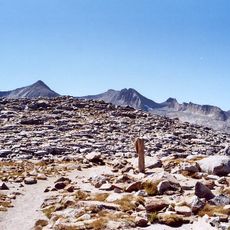
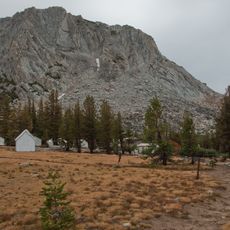
Cathedral Peak, Granite peak in Yosemite National Park, US.
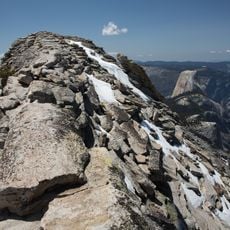
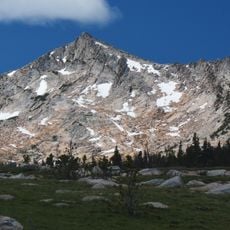
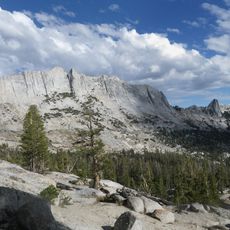
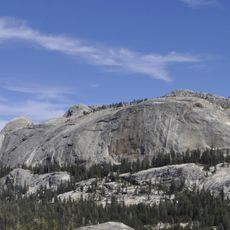
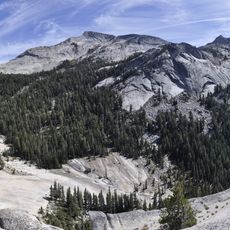
Cathedral Peak is a granite mountain in Yosemite National Park with a distinctive, nearly cube-shaped summit that reaches about 10,916 feet above sea level within the Cathedral Range. Steep walls of light-colored granite define the entire formation and make it recognizable from many viewpoints.
Cathedral Peak is the youngest intrusion of the Tuolumne Intrusive Suite, a granodiorite dated to 83 million years ago in the Cretaceous, rich in microcline phenocrysts. It was first climbed by John Muir in 1869. During the Tioga glaciation the summit stood above the ice as a nunatak, while glaciers sharpened its base and plucked its sides.
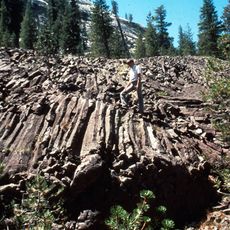
The name comes from the peak's cathedral-like form. In 1862 Hanks, Hutchins and Corcoran called it Cathedral Spires; Josiah Whitney's California Geological Survey changed it to Cathedral Peak in 1863. John Muir compared its square body and symmetrical roof to a building, noting joints in the granite set the ridge's northeast-southwest trend.
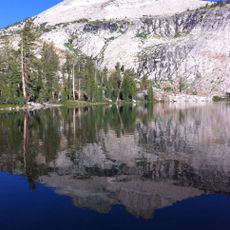
The summit is reached only by a longer climb rated grade III, with the summit block at grade IV; the standard approach starts from Upper Cathedral Lake near Cathedral Pass, reached by trail from Tuolumne Meadows. The southeast buttress of the main peak, formed by the shallower of two joint sets dipping at 65 degrees, is popular with climbers. Plan for a full day and settled weather.
Cathedral Peak stood above the ice as a nunatak during the Tioga glaciation, the last ice age. The glaciers never covered its summit; they sharpened and carved its base instead. John Muir had already noted in 1869 that the peak rises about 1,500 feet above the ridge it stands on.
The community of curious travelers
AroundUs brings together thousands of curated places, local tips, and hidden gems, enriched daily by 93,180 contributors worldwide.