Quarai, Archaeological site and Spanish mission ruins in Mountainair, United States.
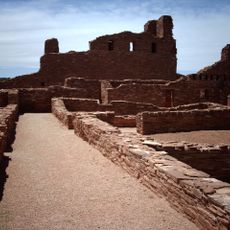
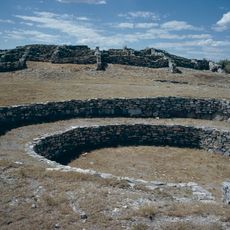
Quarai is a Spanish mission complex and pueblo settlement with red sandstone walls standing in the desert landscape north of Mountainair. The ruins show the foundations and walls of buildings that once sheltered generations of residents and reveal how daily life was organized at this place.
The Quarai, a Southern Tiwa Pueblo band, settled here around 1300 AD and had built the large pueblo compound by the early 17th century. In 1626 they received Spanish missionaries and permitted construction of the mission Nuestra Señora de la Purísima Concepción de Quarai, completed in 1632. A severe drought from the late 1660s and Apache attacks led to abandonment in 1675; survivors moved to the Rio Grande valley south of present-day Albuquerque.
The name Quarai comes from the Tiwa word 'Kuah-aye', referring to the area where the Quarai band lived. Spanish documents called the people 'Cuarac'. The mission church, Nuestra Señora de la Purísima Concepción de Quarai, was completed in 1632 and served the community until its abandonment in 1675.
Quarai lies about 8 miles (13 km) north of Mountainair, where the monument's main visitor center is; the ruins sit in open desert with little shade. Paths cross uneven ground among the pueblo mounds and mission walls, so wear sturdy shoes and carry water. The church walls, three to six feet thick, are the easiest landmark for orientation.
The mission church at Quarai was probably one of the largest wall-and-beam structures in North America, with walls three to six feet thick that rose to about 40 feet. The Lucero brothers used its ruined convento as a sheep pen in the 1820s and built an irrigation system from stone and brick salvaged from the ruins.
The community of curious travelers
AroundUs brings together thousands of curated places, local tips, and hidden gems, enriched daily by 93,874 contributors worldwide.