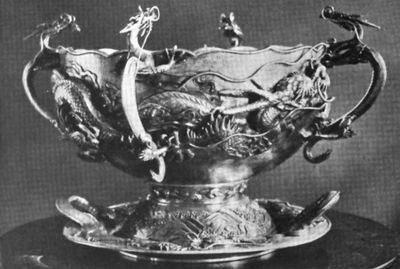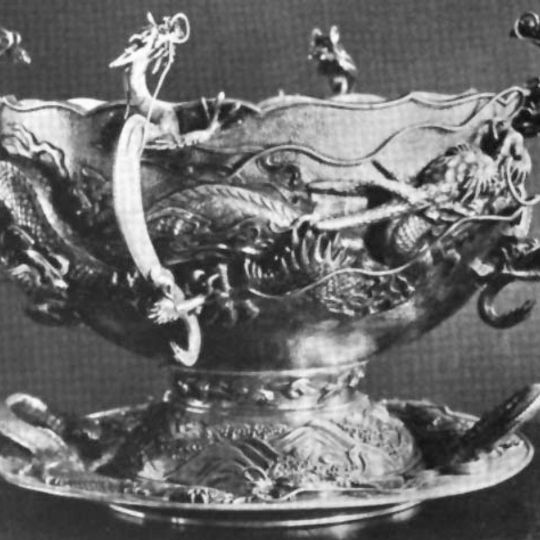
Liscum Bowl, Silver punch bowl at Fort Carson, Colorado, United States.
The Liscum Bowl is a sterling silver punch bowl set made in 1902, now at Fort Carson, Colorado. The bowl measures 2 feet 4 inches in diameter, 3 feet 3 inches handle to handle and 1 foot 9 inches high, holds about 15 gallons, and weighs 95 pounds with its ladle, tray and cups. Four Imperial dragons form the handles, peering over the rim.
On 15 July 1900, two days after Tianjin fell, the 9th Infantry Regiment found a mint holding silver bullion and coins in the burning American sector and guarded it. Two fused masses of silver, 90 pounds in all, were later presented to the regiment by order of Li Hongzhang. Officers voted for a punch bowl; 52 cups were made in Beijing, and Japanese silversmiths at Arthur & Bond in Yokohama finished the bowl, ladle and tray on 2 November 1902.
The four handles are Imperial dragons peering over the rim, a design the regiment itself suggested. A 1920 Jewelers' Circular report praised the chasing and repoussé work in intertwined dragons on the bowl and on the heavy ladle, which holds nearly a pint, as excellent examples of the best Japanese work of its kind.
The Liscum Bowl is held at Fort Carson, Colorado, where it is not on public display. Access is through the 2nd Infantry Division Museum at Camp Red Cloud, Korea, which held it for 12 years until 2018. The set weighs 95 pounds (43 kg), so moving it requires planning.
Every officer who served with the 9th Infantry Regiment in Asia between 1900 and the Korean War has his name engraved on the silver cups. These names transform the set into a memorial for generations of soldiers.
The community of curious travelers
AroundUs brings together thousands of curated places, local tips, and hidden gems, enriched daily by 93,895 contributors worldwide.