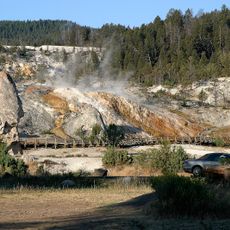
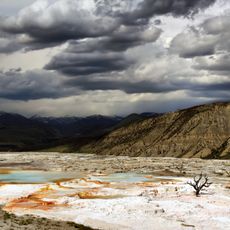
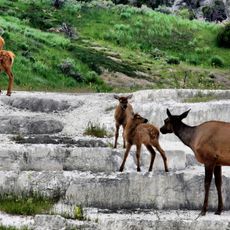
Sheepeater Cliff, Basalt cliff in Yellowstone National Park, United States.
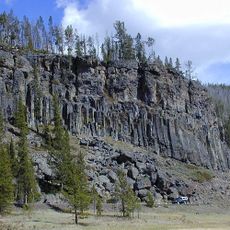
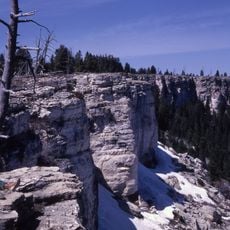
Sheepeater Cliff is a series of exposed cliffs of columnar basalt in Yellowstone National Park, cut by the Gardner River near Bunsen Peak. The rock shows well-defined joints and hexagonal columns, and some cliffs stand just off the Grand Loop Road.
The basalt erupted from a now-extinct volcano across the Grand Loop Road roughly 200,000 to 300,000 years ago, and the Gardner River later cut down to expose it. In autumn 1879 Philetus W. Norris descended into the canyon and found scattered firebrands and decaying lodge-poles, traces of the Tukudeka band called "sheep eaters", and the name was given to the cliffs. A trail was later built along the canyon rim, and the name came to cover the columns near the trailhead.
The name comes from the Tukudeka, a Shoshone band called "sheep eaters". In autumn 1879 Philetus Norris found scattered firebrands and decaying lodge-poles in the canyon, traces of a recent camp. The Tukudeka set greater store on Obsidian Cliff to the south, where they left offerings before quarrying obsidian for trade.
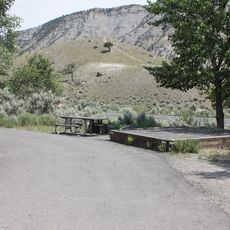
The cliff is accessible through a paved parking area located south of Mammoth Hot Springs on the main park road. The site is easy to reach and the formation is clearly visible from the parking area.
The Tukudeka, the Shoshone band called "sheep eaters", valued nearby Obsidian Cliff far more: they left offerings there before quarrying obsidian for trade. In autumn 1879 P. W. Norris found firebrands and decaying lodge-poles in the canyon, traces of a camp less than 6 miles from Mammoth Hot Springs.
The community of curious travelers
AroundUs brings together thousands of curated places, local tips, and hidden gems, enriched daily by 92,882 contributors worldwide.