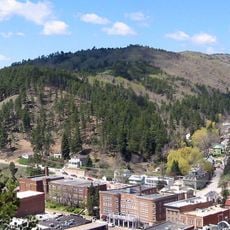
Homestake experiment, Underground physics laboratory in Lead, South Dakota
The Homestake experiment was an underground research installation built within a former gold mine where a large tank filled with chemical solvent sat buried deep beneath South Dakota. Instruments monitored this chamber to track and measure particles traveling to Earth from the Sun.
Raymond Davis Jr. began this research effort in 1970 using the abandoned mine shaft and continued until 1994. These decades of work revealed something surprising about how the Sun works and challenged scientists to rethink fundamental assumptions.
The community witnessed a profound shift as a mining operation transformed into a window on the universe. Locals saw their landscape repurposed from extracting resources to unlocking mysteries about the cosmos.
The research chamber sits roughly a mile and a half (2.4 kilometers) underground, which protects instruments from interference caused by cosmic rays. Visitors should expect narrow passageways and cool, damp conditions typical of abandoned mines.
The experiment recorded far fewer solar particles than theory predicted, capturing only roughly one-third of expected numbers. This puzzle sent physicists around the world on a decades-long quest to understand what they had missed, ultimately changing how scientists think about matter itself.
The community of curious travelers
AroundUs brings together thousands of curated places, local tips, and hidden gems, enriched daily by 60,000 contributors worldwide.