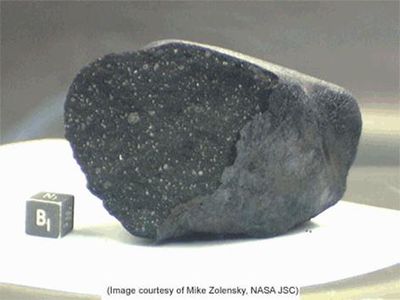
Tagish Lake, Carbonaceous chondrite meteorite in British Columbia, Canada.
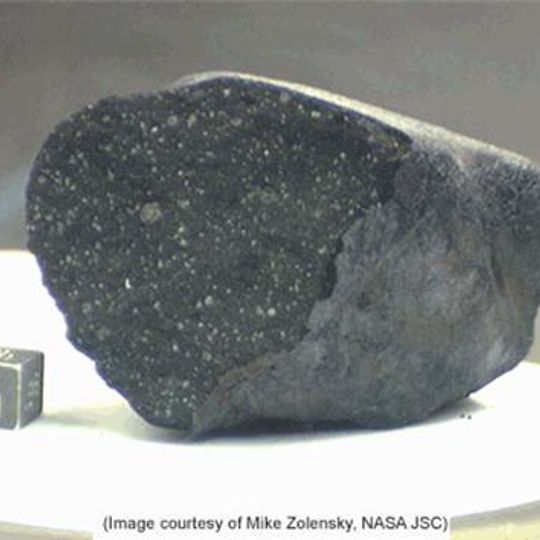
Tagish Lake is a carbonaceous chondrite meteorite composed of dark gray to black rock fragments containing small colored mineral inclusions. The material fell and landed on the frozen lake surface, where hundreds of pieces were later found scattered across the ice.
The meteorite entered Earth's atmosphere on January 18, 2000, creating an explosion detected by satellites and seismic instruments at an altitude between 30 and 50 kilometers. Its impact on the frozen lake surface resulted in the discovery and collection of over 500 fragments, making it one of the largest meteorite accumulations ever found.
Scientists study this meteorite to understand the formation of the solar system, as it contains unchanged stellar dust granules from its initial creation.
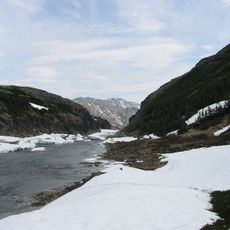
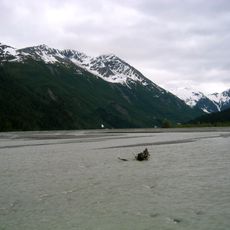
The meteorite fell in a remote area near the Taku Arm of Tagish Lake in wilderness British Columbia, which is difficult to access directly. Most material has been collected for scientific study, so visitors interested in the event will need to seek information from local museums or research institutions rather than visiting the original site.
This meteorite contains an exceptionally high concentration of nanodiamonds that formed during the solar system's early creation. Some of the organic molecules within it may have originated in interstellar space before reaching Earth, giving the discovery special significance for understanding the origins of life's building blocks.
The community of curious travelers
AroundUs brings together thousands of curated places, local tips, and hidden gems, enriched daily by 92,052 contributors worldwide.