Alberta Aviation Museum, Aviation museum in Edmonton, Canada.
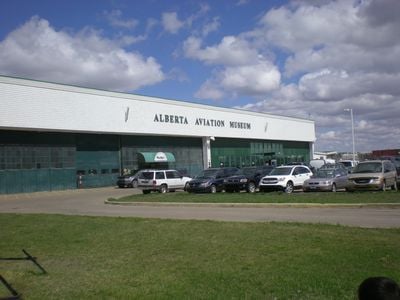
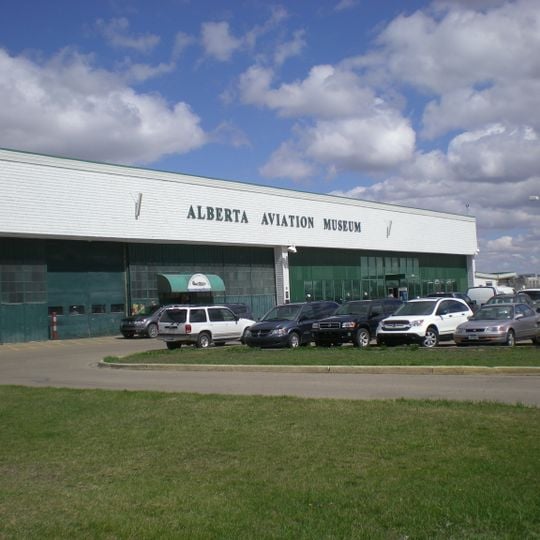
The Alberta Aviation Museum occupies Hangar 14, a Second World War British Commonwealth Air Training Plan hangar completed in 1943. The building has a rectangular plan of 6,689 square metres and a clear span of 34 metres, divided by a firewall that also serves as a support truss. Its exterior shows white horizontal siding with the museum name in black capitals, a dark glazed section and a deep green panelled section.
Hangars were built on the Blatchford Field site from 1939 to 1942 for RCAF Station Edmonton, and one opened on 5 October 1940 as No. 2 Air Observers School under Wop May. Hangar 14 was completed in 1943, served No. 418 (City of Edmonton) Reserve Squadron and Pacific Western Airlines after the war, and became a car dealership in the late 1960s. It was designated a Provincial Historic Resource in 2000 and a Municipal Historic Resource in 2004.
The building is nicknamed "The Hangar on Kingsway" and was successively designated 'M' Hangar, Hangar #6 and Building #14 by the city airport. The museum also houses the 504 Blatchford Field Squadron of the Royal Canadian Air Cadets, the 180 (20th Field Artillery Regiment, RCA) Royal Canadian Army Cadets, 700 (City of Edmonton) Wing of the Royal Canadian Air Force Association, and CASARA, whose cadet and association activities run alongside the aircraft displays.
The museum occupies Hangar 14 at 11410 Kingsway NW, on the southwest corner of the former Edmonton City Centre (Blatchford Field) Airport. It opens daily except Christmas Day, Boxing Day and New Year's Day. The hangar is a single-storey building with a flat roof; the entrance sits under a small green and white canopy near the centre-left of the facade, beside a dark glazed section and a deep green panelled section.
Hangar 14 is one of the last two surviving 'double-double' British Commonwealth Air Training Plan hangars, four units joined into one building. Its 6,689 square metres are split evenly by a firewall that doubles as a support truss, giving a clear span of 34 metres. The pre-cut British Columbia fir frame was raised in 1943.
The community of curious travelers
AroundUs brings together thousands of curated places, local tips, and hidden gems, enriched daily by 93,027 contributors worldwide.