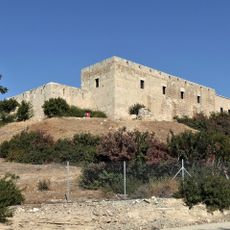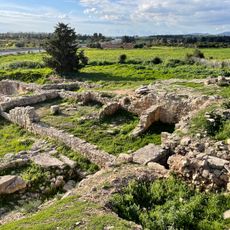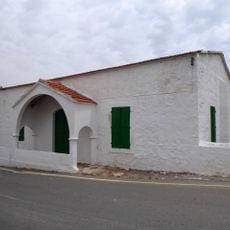
Sanctuary of Aphrodite at Kouklia, Archaeological site and museum in Kouklia Village, Cyprus.
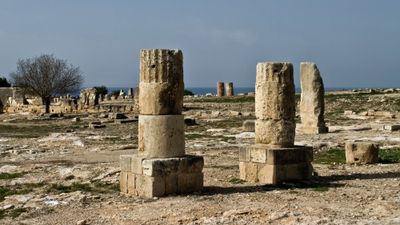
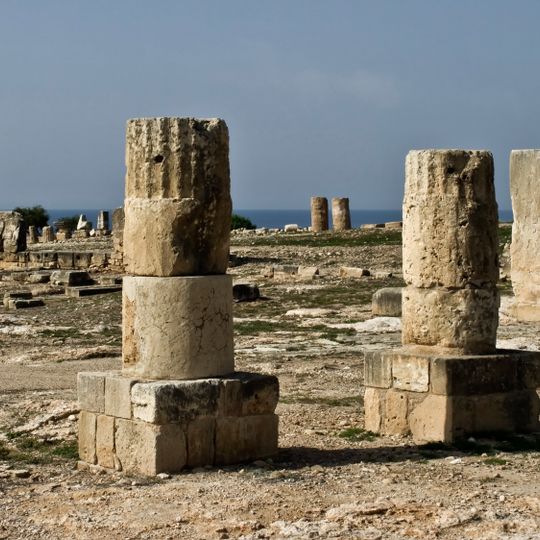
The Sanctuary of Aphrodite at Kouklia preserves the monumental ashlar temenos built around 1200 BC, its circuit marked by huge foundation walls. Two thick cylindrical columns of stacked pale stone sections stand on stepped, squared bases on dry rocky ground; one keeps a fluted capital, the other a plain top. Scattered fragments and low remnant walls lie behind them.
The sanctuary was founded around 1200 BC, when the monumental ashlar temenos was built as the urban cult centre of the city-state of Paphos, itself established around 1700 BC. It operated for over fifteen centuries, becoming a major pan-Mediterranean religious centre in the Ptolemaic and Roman periods. It was destroyed by an earthquake and rebuilt under Vespasian, and declined in the late 4th century AD during the persecution of pagans in the late Roman Empire.
Priestesses and priests called Kinyradai, said to descend from Kinyras, led the cult; inscriptions suggest they answered to a senate and popular assembly. The sanctuary also housed an oracle consulted by worshippers. Tacitus records that no blood was shed on the altar, where offerings were made only with prayers and pure fire.
The site is open daily for visitors to explore both the ruins and the museum displays. Plan to visit early in the day, especially during summer months, to avoid the midday heat and have a more comfortable experience.
Tacitus described the object of worship here as a circular mass, broader at the base and rising like a turning-post to a small top, not in human form. He also noted that the altar stood in the open air yet was never wet by rain, and that offerings were made with prayers and pure fire, without bloodshed.
The community of curious travelers
AroundUs brings together thousands of curated places, local tips, and hidden gems, enriched daily by 92,788 contributors worldwide.