Jewish cemetery in Währing, Jewish cemetery from 1784 in Döbling, Austria.
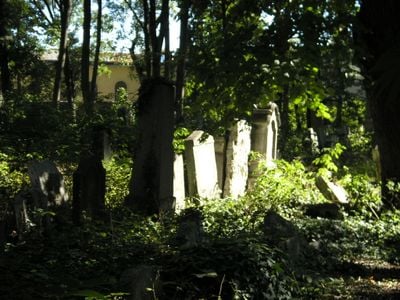
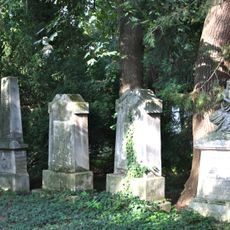
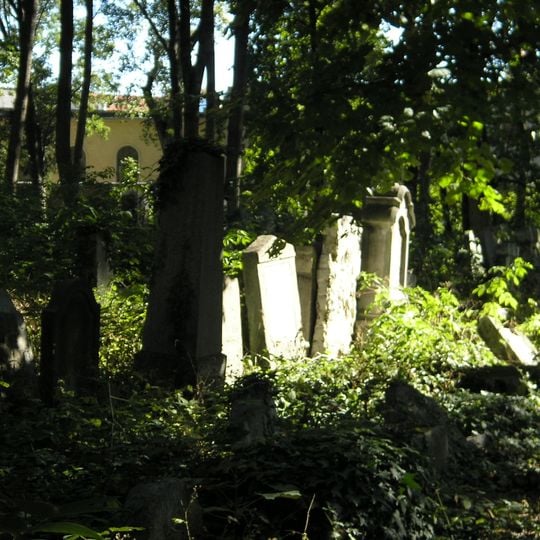
The Jewish cemetery in Währing is a walled burial ground in Vienna's 19th district, Döbling, entered at Schrottenbachgasse 3. Its two hectares hold upright gravestones of light and dark grey stone, mostly rectangular slabs with rounded or flat tops, set among ivy and low plants; the tallest, left of centre, is dark and heavily weathered. A building stands in the background.
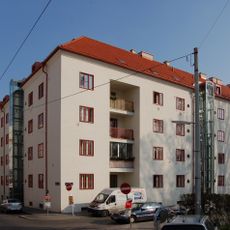
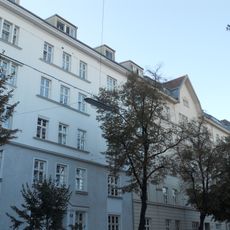
The Jewish community bought a two-hectare plot beside the new General Währing Cemetery in 1784, after Joseph II's sanitation ordinance closed Vienna's inner-city graveyards, and opened the walled cemetery the same year. It was enlarged three times and held roughly 8,000 to 9,000 graves before the Jewish section of the Zentralfriedhof opened in 1879; the last documented burial in an existing family grave was in 1911. During the Nazi period more than 2,000 graves were destroyed by excavation for a bunker that was never built, and in 1942 the community was forced to sell the site to the City of Vienna. After 1945 it was returned, but the destroyed part went to the city, which built the Arthur-Schnitzler-Hof housing block there in the 1960s.
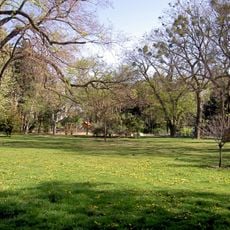
Gravestones here carry inscriptions in Hebrew and usually also in German, unlike the Roßau cemetery, where only Hebrew was used. Around 1900 an avenue of lime trees was planted down the middle of the disused ground; in traditional belief such trees at the priest graves lift the separation of those graves from the surrounding ones, a sign of the liberal outlook of Vienna's Jewish community at the time.
The cemetery is closed to visitors because the gravestones and vegetation pose a safety risk and liability questions remain unresolved. The entrance is at Schrottenbachgasse 3, in Vienna's 19th district of Döbling, not in Währing. Since 2006 politicians and experts have debated a restoration.
The cemetery's lime avenue, planted around 1900 down the middle of the disused ground, was a deliberate liberal gesture: in traditional belief, limes set beside the priests' graves lift the separation between those graves and the surrounding ones.
The community of curious travelers
AroundUs brings together thousands of curated places, local tips, and hidden gems, enriched daily by 93,898 contributors worldwide.