Hohe Villerspitze, Mountain summit in Tyrol, Austria
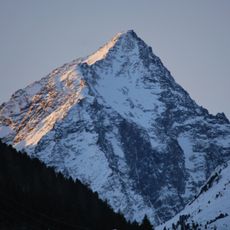
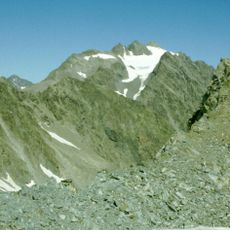
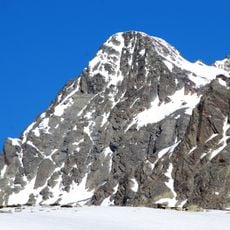
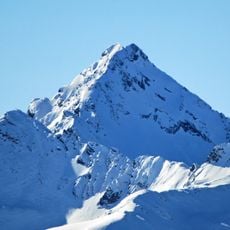
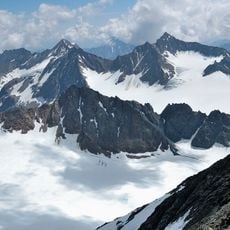
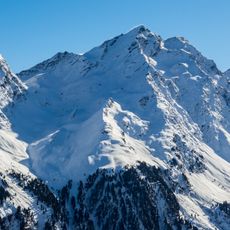
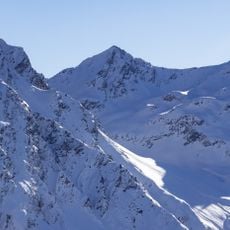
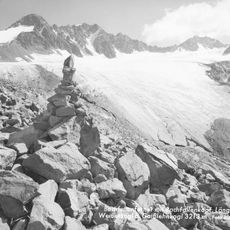
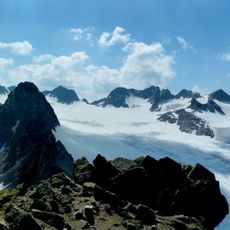
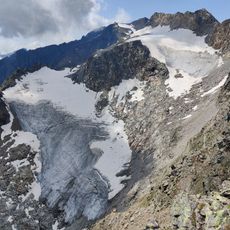
Hohe Villerspitze is a mountain summit in the Stubai Alps featuring three distinct peaks at varying elevations that create a recognizable skyline. The main peak reaches about 3,087 meters (10,128 feet), with the other two towers rising slightly lower and composed of amphibolite rock.
Carl Gsaller from Innsbruck reached the summit alone on 20 July 1878, on a second attempt after his guide Alois Tanzer had failed on 1 October 1877. Gsaller started at the Stöcklenalm in the Oberbergtal and climbed via the Horntaler Joch and the Schiefe Gang, a series of rock bands and cracks, taking ten hours. His route, rated UIAA II, is still the normal way today.
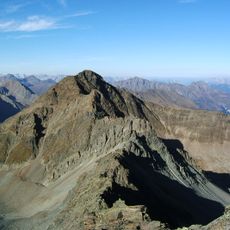
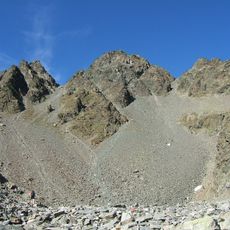
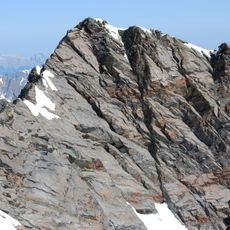
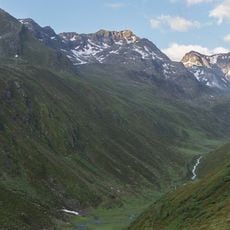
The name Villerspitze refers to the Villertal, the valley below the mountain. The three rock towers are made of amphibolite, a dark metamorphic rock that gives the summit its massive appearance. Climbers still use the route of the first ascensionist, which leads through the Schiefer Gang, a series of geological bands and cracks in the rock.
The approach follows the northwestern ridge and requires rock-climbing skills and alpine experience. The Franz-Senn-Hütte nearby offers shelter during the main climbing season and serves as a convenient starting point for the ascent.
The mountain features three separate peaks at different elevations: 3,087 meters for the southwestern tower, 3,081 meters for the middle, and 3,024 meters northwestern.
The community of curious travelers
AroundUs brings together thousands of curated places, local tips, and hidden gems, enriched daily by 92,984 contributors worldwide.