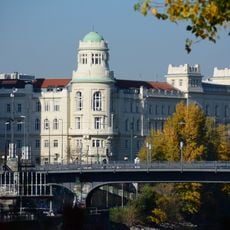
Palais Schlick, Renaissance palace in Alsergrund, Vienna, Austria.
Palais Schlick is a five-storey corner building in early historicist style at Türkenstraße 25 and Schlickgasse 1 in Vienna's Alsergrund district. Its round corner tower was originally one storey lower and ended at the dentil cornice; the top floor was added in 1872 and built slightly lower to keep the side fronts looking raised. Pilasters between the tower windows give way to caryatids on the fourth floor.
The site held Vienna's Rabenstein, the city's high court and execution terrace, a round brick platform used from 1270 until 1788. Carl Tietz then built the five-storey rental palace in 1856–58 for Count Franz Heinrich von Schlik, with Anton Grünn as builder, on the unfilled glacis of Neu-Wien. The corner tower's top floor was added only in 1872.
The address preserves the name of the Schlik family, who commissioned the building; the corner tower's fourth floor carries caryatids in place of pilasters, and the Türkenstraße front is centred on a three-axis round portal. The site itself was the Rabenstein, Vienna's execution ground, from 1270 to 1788.
The palace stands at the corner of Türkenstraße 25 and Schlickgasse 1 in Alsergrund, a corner house rather than a museum, so the facades and the round corner tower are seen from the street. Look up from the pavement: the caryatids sit on the fourth floor of the tower, above eye level.
The site held Vienna's Rabenstein, the city's high court and execution ground, from 1270 to 1788; condemned prisoners were beheaded on a round brick terrace here. The palace was then built on the still-unfilled glacis, and the corner tower only received its top floor in 1872, kept slightly lower to preserve the look of the raised side facades.
The community of curious travelers
AroundUs brings together thousands of curated places, local tips, and hidden gems, enriched daily by 92,726 contributors worldwide.