Palmenhaus, Art Nouveau greenhouse in Burggarten, Austria
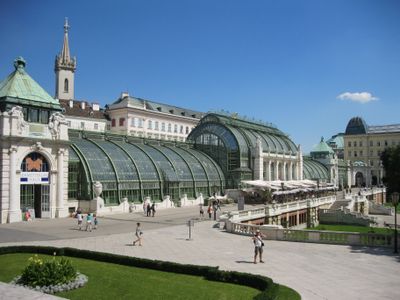
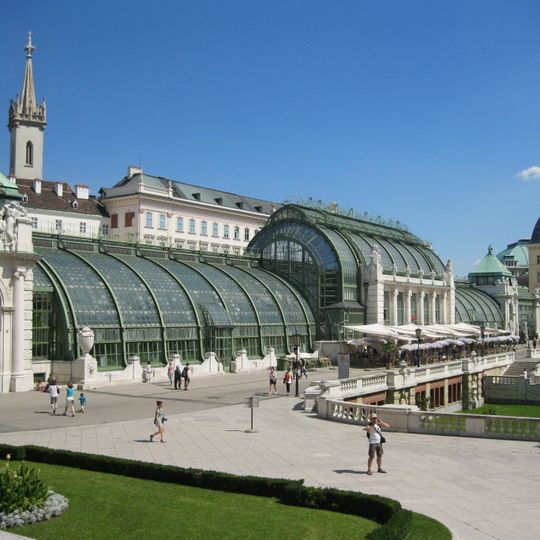
The Palmenhaus is a steel and glass greenhouse in the Burggarten of the Innere Stadt, featuring Art Nouveau details in its exterior design. The building houses a restaurant, a butterfly collection, and areas with tropical plants.
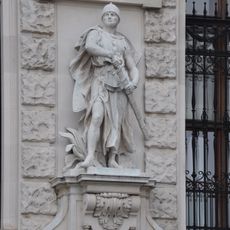
The first greenhouse on this site was built from 1823 to 1826 to plans by Ludwig von Remy, modelled on the Schönbrunn Orangery, with its rear wall forming part of Vienna's city wall. It was demolished around 1901, and Friedrich Ohmann designed the present Art Nouveau building, erected from 1902 to 1906, with decorations on the central section by Josef Václav Myslbek. From 1919 to 1938 it housed the Kunstgemeinschaft artists' association; after closure in 1988 it was restored from 1996 to 1998.
The name refers to its original purpose as a place to grow tropical plants and palms for the imperial gardens. Today visitors use it for breaks, watching butterflies, or simply walking through different sections.
The building runs 128 metres along the edge of the Burggarten, with the entrance side facing the park walkway and the Albertina nearby. The central section is a restaurant, the left wing holds the Butterfly House and the right wing is a working greenhouse of the Austrian Federal Gardens, so the three parts are entered separately. The raised terrace with parasols in front of the glass wings is the outdoor seating area.
The rear wall of the first greenhouse, built 1823–1826 to Ludwig von Remy's plans, was itself part of Vienna's city wall. That wall was lost when the building was demolished around 1901 and replaced by Friedrich Ohmann's Art Nouveau structure of 1902–1906, so no medieval masonry survives in today's Palmenhaus.
The community of curious travelers
AroundUs brings together thousands of curated places, local tips, and hidden gems, enriched daily by 92,654 contributors worldwide.