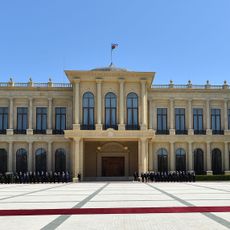
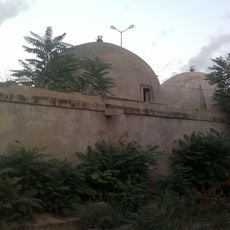
Нардаранская Мечеть, Islamic mosque in Nardaran district, Azerbaijan
The Nardaran Mosque is a place of worship in the Nardaran district featuring four minarets and intricate Islamic geometric patterns on its walls. The building displays traditional design elements with detailed tilework and carved stone surfaces throughout.
The oldest part, a mosque room and tomb, was built in 1363–1364 under the Shirvan-Absheron school, as recorded in a construction inscription above the prayer hall door. The inscription names Khwaja Haji Hamza ibn Qutlu Mahmud Shahabadi, chief vizier of Shirvanshah Kavus ibn Keyqubad (1348–1372). The building lay buried under sand until 1950, was used as a grain store from 1951, and was restored by locals in 1956; a second storey was added over the tomb in 1994.
This mosque serves as a spiritual center for the Shia community and hosts religious gatherings throughout the year. The space reflects the deep connection local people have maintained with their faith across generations.
Visitors should wear appropriate clothing and respect local customs when entering the building. The best time to visit is outside of prayer times to explore the space without disrupting religious activities.
The oldest part of the complex, a mosque room and a burial chamber, lay buried under sand for centuries and was only uncovered in 1950. The tomb has no outside door: it is entered through a pointed arch (1.13 x 0.58 m) opening from the prayer room. In 1951 the building was turned into a grain store, and locals cleared it again in 1956.
The community of curious travelers
AroundUs brings together thousands of curated places, local tips, and hidden gems, enriched daily by 93,364 contributors worldwide.