Neolithic flint mines of Spiennes, Neolithic flint mines in Spiennes, Belgium
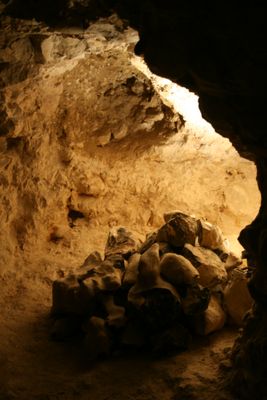
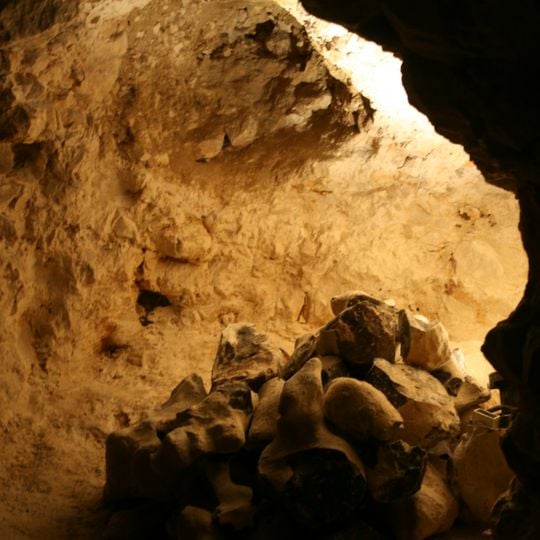
The Neolithic flint mines of Spiennes cover about 100 hectares of downland near the village of Spiennes, southeast of Mons. The site holds thousands of vertical shafts, some over 10 metres deep, dug to reach flint layers; underground galleries branch from these shafts. The photograph shows an excavated cavity with fractured pale tan and ochre walls and a pile of broken rock and nodules at the bottom.
Flint was mined here between about 4300 and 2200 BC. The site was first noticed in 1843, and in 1867 the cutting of the Frameries–Chimay railway exposed 25 shafts, prompting study by the mining engineer Alphonse Briart and others, presented in Brussels in 1872. Large-scale excavation began in 1889, and shafts with a connecting gallery were cleared from 1912. The mines are linked to the Michelsberg culture and joined the UNESCO World Heritage list in 2000.
The mines are linked to the Michelsberg culture. Rough-outs were traded up to about 150 km away and often polished at their destination, while finished tools reached distances of 50 to 160 km. Excavations also yielded flint blades, pottery, animal bones of cattle, pigs, goats and sheep, and human skeletons.
The SILEX'S centre at Petit-Spiennes has a surface museum and a multimedia presentation of the mines; the mines and excavations can be visited on certain days and by appointment. The site lies in three sectors: Camp-à-Cayaux, Petit-Spiennes and Versant de la Wampe. Book ahead, since underground access depends on guided slots.
The mine walls at Spiennes were cut with flint picks and antler tools, and unsuitable stone was dumped back into already worked galleries. Some galleries ran up to 7 m and could reach a neighbouring shaft. The deepest shafts, in the 65 ha Camp-à-Cayaux sector, went down 16 m.
The community of curious travelers
AroundUs brings together thousands of curated places, local tips, and hidden gems, enriched daily by 93,628 contributors worldwide.