Rabot, Medieval defensive monument in Ghent, Belgium.
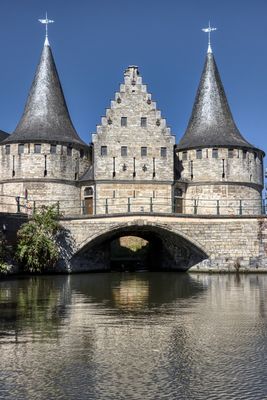
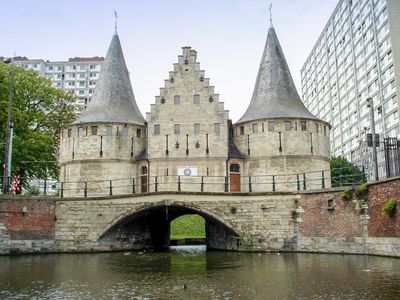
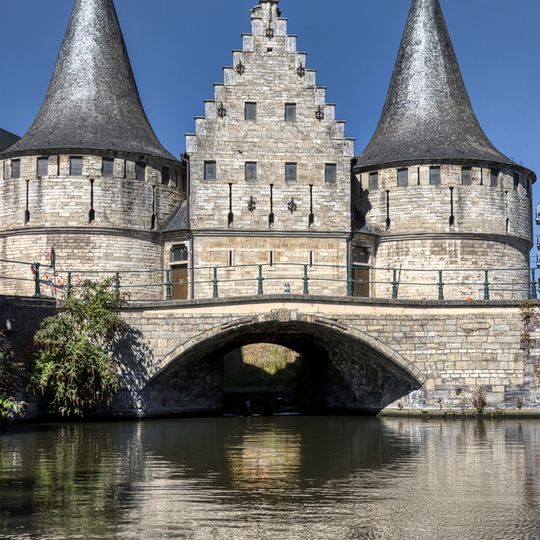
The Rabot is a fortified sluice at the crossing of the Lieve canal and Ghent's city moat, completed in 1491. Two round towers with steep slate conical roofs and spires flank a central block with a stepped gable, all in pale grey stone above a low arch bridge. Small dark windows pierce the towers; a white sign with a circular emblem hangs on the facade.
In 1488 Ghent's militia withstood a 40-day siege by Emperor Frederick III's army, which withdrew from the spot where the Rabot now stands. The Ghentenaars answered by raising two monumental towers on the existing weir in the Lieve canal; the fortified sluice at the junction of the Lieve and the city moat was finished in 1491. After Maximilian's victory in 1492 he ordered the towers demolished as punishment, but the city refused and negotiated the sentence down to a heavy fine.
Locals call the centuries-old towers "de Torekens". Nearby streets recall the 1488 siege: Triomfstraat marks the victory over Frederick III's army, and Filips Van Cleeflaan honours the Ghent leader Filips van Kleef (1459–1528). The name Rabot comes from French "rabattre", the wooden weir that once held back the water of the Lieve.
The Rabot sits right along a busy street and is easy to reach on foot from the city center. Be aware that the interior may not always be open to visitors, but you can view and appreciate the exterior stonework and architectural details from the public area outside.
Locals call the centuries-old towers "de Torekens". Streets nearby recall the 1488 siege: Triomfstraat (Triumph Street) and Filips Van Cleeflaan, named after the Ghent leader Filips van Kleef (1459–1528). The name Rabot itself comes from French "rabattre", the lowering of horizontal beams in a water weir.
The community of curious travelers
AroundUs brings together thousands of curated places, local tips, and hidden gems, enriched daily by 94,058 contributors worldwide.